

Why Reaching Unchurched Students Matters More Than Ever
Reaching unchurched students is one of the most urgent and strategic opportunities facing the Church today. Here’s what you need to know to get started:
Key Strategies for Reaching Unchurched Students:
- Build authentic relationships – Friendship evangelism based on genuine connection is the most effective approach
- Create welcoming environments – Eliminate insider language and make your space accessible to newcomers
- Leverage student networks – Equip Christian students to reach their peers through existing friendships
- Address real questions – Engage objections and misconceptions with empathy and truth
- Focus on multiplication – Develop student leaders who can disciple others, not just grow attendance
- Make prayer foundational – Pray specifically for students by name and for divine appointments
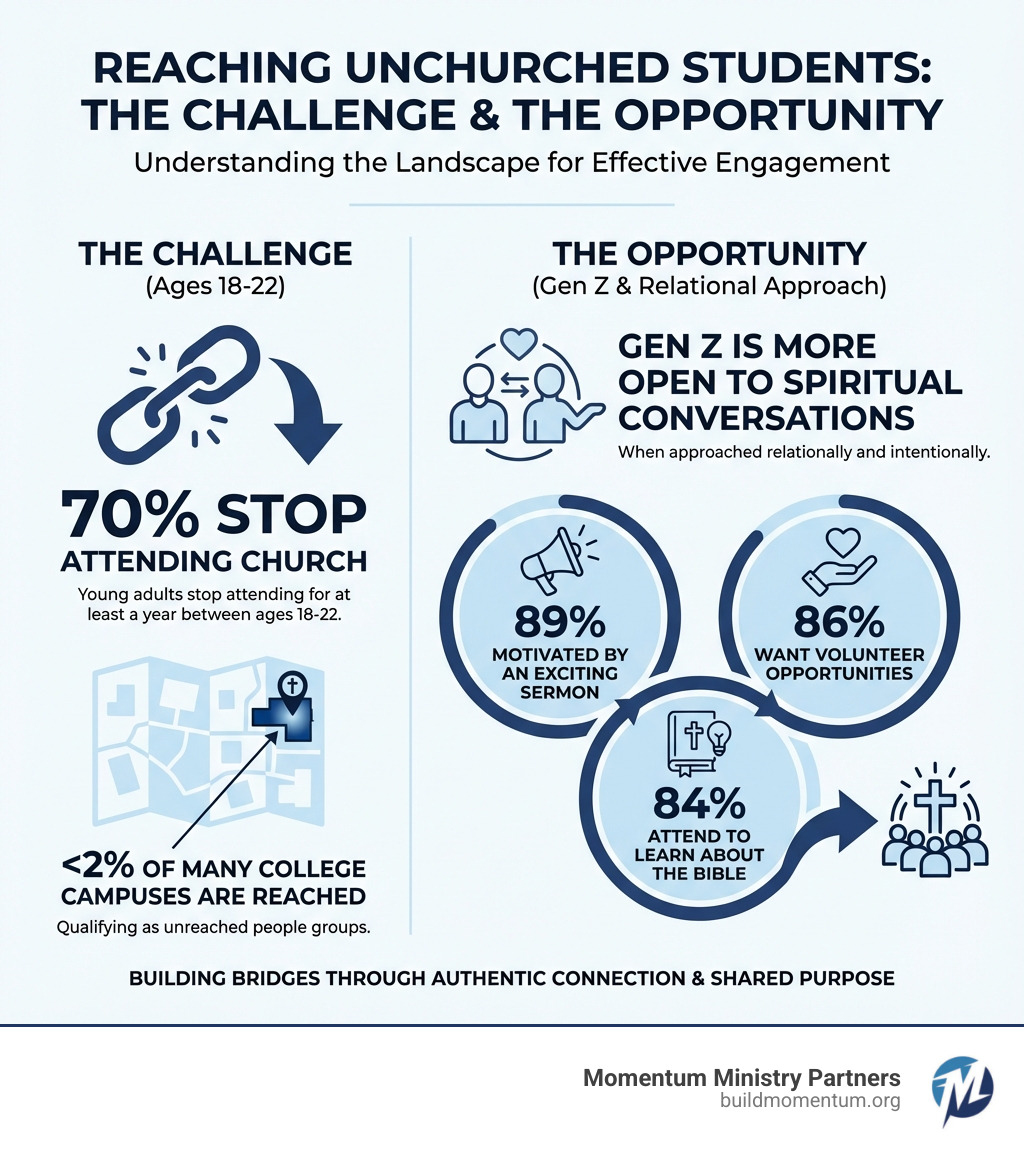
The statistics are sobering. 70 percent of young adults stopped attending church for at least a year between ages 18 to 22, according to Lifeway Research. Many college campuses are less than 2% reached, qualifying them as unreached people groups by missiological standards. Yet research from Barna shows that Gen Z is more comfortable in spiritual conversations than previous generations when approached relationally and intentionally.
This creates an incredible window of opportunity for reaching unchurched students with authenticity, clarity, and patience. Students today are searching for authenticity, community, and truth in a fragmented digital world. They’re facing unprecedented pressures from social media, constant connectivity, and cultural confusion about identity and purpose. The unchanging message of Jesus Christ offers exactly what they’re looking for, even when they don’t realize it yet.
I’m Jeff Bogue, President of Momentum Ministry Partners and Senior Pastor of Grace Church, where we’ve spent decades developing strategies for reaching unchurched students across multiple campuses and contexts. Through our work equipping ministry leaders and building discipleship pathways, I’ve seen how effective, relationship-based approaches to reaching unchurched students can transform both individual lives and entire faith communities.
Understanding Today’s Unchurched Student
Before we can effectively reach unchurched students, we must first understand them. This generation, often referred to as Gen Z, navigates a world vastly different from those before them. Their mindset, needs, and worldview are shaped by unique pressures and opportunities.

Primary Characteristics and Needs
Today’s unchurched students are digital natives, having grown up with the internet and social media as an integral part of their lives. This hyperconnectivity brings both challenges and opportunities. While it can lead to comparison traps and anxiety, it also fosters a craving for authentic connection and genuine community that often feels lacking in their online interactions.
They are deeply community-oriented, often seeking belonging and acceptance within peer groups. This desire for connection makes relationship-building a critical entry point for ministry. We see students struggling with questions of identity, exploring who they are and where they fit in the world. They are also often deeply concerned with social justice, seeking to make a tangible difference in the world around them.
Perhaps surprisingly, Gen Z is often very open to spiritual conversations. Research from Barna indicates they are more comfortable discussing spiritual matters than previous generations, especially when approached in a relational and intentional way. This openness, combined with the significant transitions many students experience (such as starting college), makes them particularly receptive to exploring faith. They are looking for answers to life’s big questions and often find themselves in situations that highlight their need for deeper meaning and purpose. This generation is navigating intense pressures, and addressing their mental health needs and identity questions is crucial. We have also written on topics such as Christian Mental Health: Walking Alongside Youth and How Can We Help Students Find Their Identity? to support leaders in these vital areas.
Common Objections and Misconceptions
When engaging with unchurched students, we often encounter a range of misconceptions and objections about Christianity and the Church. Many students perceive the Church as hypocritical, judgmental, or irrelevant to their lives. They may have heard negative stories or had personal experiences that have colored their view of faith.
Questions about the intersection of science and faith, the problem of suffering in the world, and Christian stances on social issues are also common. These aren’t always hostile attacks but often genuine inquiries from a generation seeking intellectual honesty and authenticity. It’s crucial that we approach these questions with empathy and respect, rather than defensiveness. We must be willing to listen, understand their perspective, and address their concerns thoughtfully, pointing them to the truth of the Bible. Our work with students often involves helping them steer these difficult questions, and articles like How to Help Your Students Overcome Doubt are invaluable in this process.
Speaking to Both Success and Struggle
Today’s students live in a world that often equates success with happiness and fulfillment. Many are driven to achieve, whether academically, professionally, or socially. However, as one insight from Carey Nieuwhof notes, “Most successful people I know are always on a quest for more. Success promises, but never (quite) fully delivers.” We have found this to be profoundly true for students. They may achieve great things, yet still feel a gnawing emptiness or anxiety.
Therefore, when reaching unchurched students, we must learn to balance acknowledging their efforts and celebrating their successes with addressing the underlying struggles and crises they may face. We need to empathize with the anxiety and pressure they feel, whether it’s academic stress, social pressures, or concerns about their future. Instead of merely condemning worldly pursuits, we can gently point to the potential emptiness of a life solely focused on external achievements. To strengthen leaders who are reaching unchurched students, we’ve created resources on mental health, identity, and doubt to help leaders engage with these realities. By presenting a Biblical worldview, we can show them that true, lasting fulfillment is found in Christ, offering a hope that transcends circumstances and speaks to the deepest longings of their hearts. Understanding and articulating a robust Christian World View becomes essential in this endeavor.
The Foundational Shift: From Programs to People
For too long, some ministries have relied on programs and events to attract students, hoping they would then encounter faith. While programs have their place, our experience shows that a foundational shift from focusing primarily on elaborate programs to prioritizing genuine relationships is essential for reaching unchurched students. It’s about belonging before believing, and authenticity over attraction.

Why Traditional Evangelism Often Fails
Traditional methods of evangelization, which often assume a basic understanding of Christian concepts or a felt need for God, can be ineffective for today’s unchurched students. The landscape has changed dramatically. In the U.S., a large share of adults now identify as religiously unaffiliated, shaping a campus reality where many students have little to no church background. This means many students have no Christian background, no shared vocabulary, and often don’t perceive a need for God in their comfortable lives.
As one insight suggests, “People are learning to live comfortably without God.” They are often met with indifference or perceived irrelevance rather than outright hostility. When our approach is based on outdated assumptions about their spiritual awareness or motivations, we miss the mark. We must recognize that the strategies of yesterday may not resonate with a generation that values authenticity and personal connection above all else. This calls for a re-evaluation of our approach to Evangelism in 2020 and beyond.
The Power of Authentic Relationships
The most effective way to reach unchurched students is through friendship evangelism, built on genuine and loving relationships. This means leaving our comfort zones and intentionally building connections with students where they are, engaging in their activities, and showing genuine interest in their lives.
Our experience, and that of many others, echoes the sentiment: “You can’t influence people you don’t know.” A powerful example comes from a troubled teenager who grew up in an inner-city setting. He recounts how a local church began to visit his apartment complex, and what he needed most was “personal attention.” That’s exactly what they gave him, changing the trajectory of his life, as noted in the research related to Luke 9:18-19.
This approach requires us to show unconditional love, listen without judgment, and be present in their lives. When we invest in building authentic connections, we create a safe space for students to ask questions, share struggles, and ultimately, encounter the love of Christ. Small groups and consistent community activities are vital for fostering these deep relationships and creating a thriving environment where students feel truly seen and valued. This is how we build 3 Ways to Make Youth Group a Thriving Community.
Making Faith Relatable Through Personal Stories
One of the most powerful tools we have in reaching unchurched students is the sharing of personal stories and testimonies. These aren’t just abstract theological concepts; they are real-life examples of God’s transformative power at work. When we vulnerably and honestly share how our faith has impacted our lives, guided us through our struggles, and brought us hope, it makes the Gospel relatable and tangible.
Students today crave authenticity. They are often skeptical of grand claims but are deeply moved by genuine personal experience. Our stories demonstrate that faith isn’t just an ancient tradition but a living, dynamic relationship that offers real solutions to life’s challenges. When we share how we’ve grappled with doubt, faced adversity, or found purpose in Christ, it creates a bridge for them to consider how faith might impact their own lives. We must equip our students and leaders to articulate their faith journeys in a compelling way, helping them understand How to Share the Gospel not just through words, but through the narrative of their lives.
Practical Strategies for Reaching Unchurched Students
With a clear understanding of today’s students and a commitment to relational ministry, we can implement practical strategies to effectively reach them. This involves servant leadership, intentional outreach, and creating abundant opportunities for genuine connection.
Creating a Genuinely Welcoming Environment
First impressions are everything when it comes to reaching unchurched students. A welcoming environment goes beyond a friendly greeting; it means actively working to eliminate “insider language” and jargon that can make newcomers feel alienated. Clear communication, straightforward signage, and an intentional follow-up process are crucial. We need to make it easy for students to understand what’s happening, where to go, and how to get involved.
One surprising, yet highly effective, draw for students is free food. Research shows that more than 68 percent of students would attend a church that offered free food on a regular basis. While it might seem trivial, it speaks to a practical need and creates a relaxed, low-pressure environment for interaction. Creating a welcoming culture means removing as many barriers as possible and showing students that they are valued and belong, regardless of their background or beliefs. This proactive approach helps us overcome potential cultural barriers within the church and ensures we are always thinking about How Churches Can Keep Youth Engaged.
Effective Methods for Reaching Unchurched Students
Reaching unchurched students requires us to be creative and flexible in our methods, embodying the spirit of 1 Corinthians 9:19, which encourages us to become “a servant to all people, that I might win the more.” This means meeting students on their turf, engaging with their interests, and leveraging existing social networks.
- Servant Evangelism: Find ways to serve students practically, without immediate expectation. This could be offering free snacks on campus, helping with moves, or simply being present in their spaces.
- Leveraging Social Networks and Hobbies: Students tend to flock together in friend groups. Instead of just trying to reach individuals, we can focus on building relationships with entire groups. This might mean engaging with their clubs, sports teams, or even their online gaming communities. For example, understanding How to Engage Video Gamers in Your Student Ministry can open new doors for connection.
- Gospel Appointments: Encourage Christian students to intentionally invite unchurched friends for coffee or a meal with the specific purpose of having a spiritual conversation. This relational, intentional approach has proven highly effective.
- Student-Led Outreach: Empowering Christian students to lead the charge in reaching their peers is incredibly strategic. They have unique access and credibility within their social circles.
These approaches are part of a broader strategy for Reaching the Unchurched: Effective Outreach Ideas that prioritizes relationship and authentic engagement.
The Non-Negotiable Role of Prayer
In all our efforts to reach unchurched students, prayer is not just a component; it is the absolute foundation. We believe that spiritual change is ultimately God’s work, and our human efforts are empowered by His divine intervention.
We must commit to praying specifically and consistently for the unchurched students in our communities and on our campuses. This means praying for their hearts to be open, for divine appointments, and for our Christian students and leaders to have boldness and wisdom. We’ve seen the power of student-initiated prayer movements on campuses. When students themselves are passionately praying and worshiping, it creates an atmosphere where God moves in profound ways. These movements often precede significant spiritual breakthroughs and decisions for Christ. As Paul Worcester aptly states, “Look under the hood of any church or collegiate ministry that’s making a significant impact among lost students and you’ll find a student-initiated movement of prayer and worship bubbling up under the surface.” This highlights the importance of fostering a culture of prayer that permeates all aspects of our ministry to students.
From Connection to Discipleship: Building a Lasting Faith
Our mission doesn’t end when a student expresses interest in faith or even makes a decision for Christ. In fact, that’s just the beginning. The goal is not merely to add members but to multiply disciples who will go on to impact their world for Christ. This requires a long-term vision for spiritual growth and leadership development.
Equipping Your Team for Effective Ministry
Reaching unchurched students effectively depends heavily on the quality and preparedness of our leaders and volunteers. It’s essential that we equip them not just with good intentions, but with practical skills and a deep understanding of the students they serve. This includes comprehensive Evangelism Training that focuses on relational approaches and empathetic listening.
Our leaders must be non-judgmental, genuinely like and believe in the students, and be adept at communicating the Gospel at their level. This means understanding Gen Z culture, their unique pressures, and their preferred communication styles. Mentoring volunteers and leaders is crucial, providing them with ongoing support, training, and opportunities for growth. We must invest in our adult leaders, helping them to be solid examples of Christ-like character and compassion. Our commitment to Christian Leadership Mentoring the Next Generation ensures that those on the front lines are well-prepared and empowered for this vital work.
Moving from Addition to Multiplication
A common pitfall in ministry is focusing solely on “addition”—growing attendance numbers. While growth is good, our ultimate aim should be “multiplication”—equipping disciples who can then make more disciples. This is especially true when reaching unchurched students. The college campus, in particular, is a strategic environment for multiplication, as students are “reachable, recruitable, trainable, and sendable.”
This requires creating an intentional leadership pipeline, where students are identified, discipled, and empowered to lead their peers. As one ministry leader states, “One of the most strategic things a church or ministry can do is create a small team of student leaders who can lead the charge in reaching their peers.” The best person to reach a student with the Gospel is often another student. Our goal is to help students move “from lost to laborer,” rapidly developing them into leaders who can share their faith and disciple others. This strategy of equipping and releasing a growing core of student leaders exponentially increases our impact and ensures that the work continues beyond our direct involvement.
The Long-Term Benefits for Students and the Church
The benefits of effectively reaching unchurched students extend far beyond immediate conversions. For the students themselves, it means lifelong faith formation, establishing a spiritual foundation during a critical, formative period of their lives. Many students are making major life decisions about their careers, relationships, and values, and introducing them to Christ during this time can shape their entire future.
For the Church, the long-term benefits are immense. These students become the next generation of leaders, not just within the church but also in their communities and workplaces. They bring fresh perspectives, energy, and a passion for mission. When students are prepared to find a Christian community after graduation, it contributes to the health and vitality of the broader Church. Our goal is to Prepare Your Students to Find a Church When They Leave Home, ensuring their faith journey continues. Investing in reaching unchurched students is an investment in church revitalization and growth, laying the groundwork for The Future of Youth Ministry Starts Here.
Frequently Asked Questions about Reaching Unchurched Students
How do we start a conversation about faith without being awkward?
Starting a conversation about faith doesn’t have to be awkward. The key is to begin with genuine interest in the student as a person. Ask open-ended questions about their life, their dreams, their struggles, and genuinely listen to their answers. Look for natural bridges to spiritual topics that arise from their interests or concerns. Often, people are more open than we think. You don’t need to have all the answers, just a willingness to engage. Our article on Tips for Faith Integration: Navigating Spiritual Conversations at Work offers valuable insights that can be applied to student interactions.
What if unchurched students ask questions I can’t answer?
It’s perfectly okay to say, “That’s a great question, and I don’t know the full answer, but I’d love to explore it with you.” These models of intellectual humility and a posture of learning are highly valued by Gen Z. Offer to find answers together, perhaps by looking at relevant passages in the Bible or consulting a trusted source. Point them to the truth of the Bible as the ultimate source of wisdom. This process can actually strengthen your relationship and demonstrate that faith is a journey of growth and discovery, not just a set of predefined answers.
What’s more important: a big, fun event or small group relationships?
Both big, fun events and small group relationships play crucial roles in reaching unchurched students, but they serve different purposes. Big events can act as a non-threatening “front door,” attracting students who might not otherwise step into a church setting. They offer a low-pressure way to experience community and a positive atmosphere. However, small group relationships are the “living room” where genuine spiritual growth and discipleship happen. It’s in these smaller, more intimate settings that students feel safe to ask deep questions, share vulnerabilities, and build authentic connections that lead to lasting faith. The ultimate goal is to integrate students into an authentic Christian community where they can experience both the broader fellowship and the intimate discipleship that leads to change. We believe in providing opportunities for both, understanding that Play with Purpose: Meaningful Youth Group Games for Building Community can open doors to deeper connections.
Conclusion: Answering the Call to the Harvest
Reaching unchurched students is not merely an option for the Church; it is a vital calling. The harvest truly is plentiful, and today’s students are more open to spiritual conversations and authentic relationships than ever before. We’ve explored how understanding their unique characteristics and needs, shifting our focus from programs to people, and implementing practical, relational strategies can make a profound difference.
This is a strategic, long-term investment that yields eternal returns—not just in individual lives transformed by Christ, but in the multiplication of disciples who will shape the future of the Church and the world. At Momentum Ministry Partners, we are committed to equipping leaders for this vital mission, providing the insights, training, and support needed to effectively reach and disciple the next generation.
We believe that by prayerfully and intentionally engaging with unchurched students, we can witness a powerful movement of God on our campuses and in our communities.
If you’re serious about reaching unchurched students, give your students a moment they can invite friends into with confidence. Momentum Youth Conference creates space for authentic community and spiritual conversations that don’t feel forced. Join us this summer!






0 Comments