

Why Understanding Who You Are in Christ Changes Everything
Biblical identity is understanding who you are based on what God says about you through Jesus Christ, rather than what the world, your past, or your feelings tell you. It’s the answer to life’s most fundamental question: “Who am I?”
This identity is not something you earn; it is a gift from God, anchored in Christ’s finished work. It means you are a new creation (2 Corinthians 5:17), a child of God adopted into His family (John 1:12), His workmanship created with purpose (Ephesians 2:10), and chosen and holy, set apart for Him (1 Peter 2:9). Unlike worldly identity markers—career, social status, or personal achievements—your Biblical Identity provides a stable foundation when everything else shifts.
In over three decades of ministry, I’ve found that most struggles with purpose, relationships, or self-worth eventually touch on this one topic: identity. Young people especially face an overwhelming barrage of messages about who they should be. Social media amplifies comparison, and culture pushes self-definition through feelings. The world offers a thousand different mirrors, each reflecting a different version of “you.”
The Bible doesn’t offer a better opinion; it offers a better foundation. As I’ve served as Senior Pastor of Grace Church and now as President of Momentum Ministry Partners, I’ve witnessed countless believers find freedom when they grasp their Biblical Identity. This truth transforms lives, equips leaders, and anchors youth in an increasingly unstable world.
God’s answer to our search for identity is clear: You are Mine. You are loved. You are known. You are called. When you know whose you are, you know who you are. In this guide, we’ll explore what the Bible says about your identity, how it contrasts with the world’s approach, and how to live out this truth in practical, everyday ways.
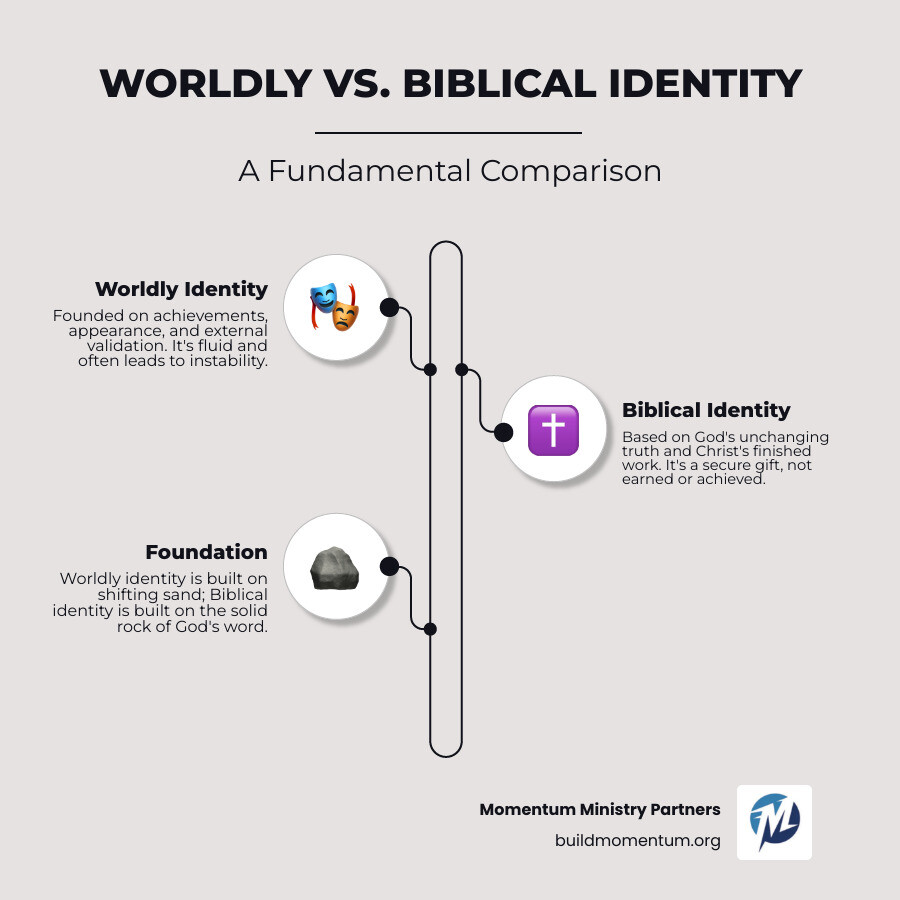
Worldly Identity vs. Christian Identity: A Fundamental Comparison
The quest for identity is a universal human experience, but the paths the world and the Christian faith offer to answer the question, “Who am I?” diverge dramatically. Understanding this difference is crucial for navigating life with stability and purpose.
Worldly identity asks us to look inward or outward for definition; Biblical identity begins with God’s declaration. Culture often defines identity as what makes you different; Scripture defines identity by who you belong to. While a starting point, this approach often lacks an objective, unchanging anchor, leaving individuals vulnerable.
Consider the influence of social media on Generation Z. McKinsey’s Health Institute notes that social media engagement can feel negative for Gen Z, even as it sometimes provides connection and support. This comparison culture, fueled by algorithms, leads to anxiety and emptiness because worldly identity markers are insecure and not designed to bear much weight. This is like building a house on sand, prone to collapse when storms come (Matthew 7:26-27).
In stark contrast, Biblical Identity is how God sees a believer through Jesus Christ and His redemptive work. It is the Creator’s authoritative answer to our deepest questions, offering an unshakable foundation.
Here’s a comparison of key aspects:
| Aspect | Worldly Identity | Christian Identity |
|---|---|---|
| Foundation | Accomplishments, status, possessions, feelings | God’s unchanging nature, Christ’s finished work, God’s Word |
| Source of Worth | External validation, personal achievements | God’s love, grace, and adoption as His child |
| Stability | Fluid, constantly changing, prone to comparison | Unchanging, secure, and anchored in Christ |
| Goal | Self-actualization, personal fulfillment | Glorifying God, serving others, becoming like Christ |
As we engage in discussions about identity, especially with youth, we must be prepared to articulate the unique and transformative power of a Christian worldview. Christian Values Meet Culture: Youth Discussion offers further insights into this vital conversation.
What is Biblical Identity and Why Does It Matter?

Biblical identity matters because it anchors purpose and belonging in something objective: God’s Word. While worldly identity is subjective and self-determined, Christian identity is divinely given and objectively true. It’s about seeing ourselves from God’s perspective.
One of the most profound aspects of Biblical Identity is its ability to supersede worldly labels. Galatians 3:28 boldly declares, “There is neither Jew nor Gentile, neither slave nor free, nor is there male and female, for you are all one in Christ Jesus.” This highlights that our identity in Christ transcends societal, racial, or economic divisions. These markers become secondary to our primary identity as unified in Christ. This unity frees us from the bondage of sin and the need to find our worth in external factors, as Romans 6:6 reminds us that our “old self was crucified with him… that we should no longer be slaves to sin.”
The Impact of Your Biblical Identity on Purpose and Belonging

Understanding your Biblical Identity has a profound impact on your sense of purpose. When we grasp that we are God’s masterpiece, lovingly crafted for good works (Ephesians 2:10), a divine purpose emerges. Jeremiah 29:11 assures us, “‘For I know the plans I have for you,’ declares the Lord, ‘plans to prosper you and not to harm you, plans to give you hope and a future.'” This affirms that our lives have meaning and direction, designed by our Creator. We are indeed Meant for More than fleeting earthly pursuits.
This divinely ordained purpose shifts our focus from self-serving desires to serving God and others. We find fulfillment not in what we accumulate, but in what we contribute to God’s Kingdom. This is a key aspect of God’s Purpose: Encouraging Youth to Pursue Godly Success.
Our sense of belonging also finds its ultimate anchor in our Biblical Identity. As children of God, we belong to a spiritual family that transcends all earthly barriers. We are “one with other believers in the body” (1 Corinthians 12:27), each a vital part of a larger whole. This belonging provides security and acceptance that no worldly community can replicate.
Living Transformed: How Your Identity in Christ Changes Everything
Embracing your Biblical Identity is a lifelong journey of change. This process, known as sanctification, involves continually “renewing the mind” (Romans 12:2). We are called not to conform to the patterns of this world but to be transformed by replacing worldly thoughts with God’s truth about ourselves.
This renewed mindset provides a stable foundation for life. Our intrinsic worth is no longer tied to performance but to the unchangeable fact that we are created in God’s image and redeemed by Christ. Extrinsic factors, like career or relationships, become opportunities to serve God rather than sources of identity. Living in your Biblical Identity also empowers you to overcome obstacles like past sin and false beliefs. In Christ, we are forgiven and made new. This truth allows us to repent and accept the freedom that comes with God’s grace, dismantling the lies that hinder our growth.
From Self-Serving to Serving God and Others
A profound shift occurs in our motivation when we grasp our Biblical Identity. Our focus moves from an inward, self-serving orientation to an outward, God- and other-serving one. This isn’t a forced duty but a natural outflow of love for God. When we know we are deeply loved, chosen, and forgiven, our greatest desire becomes to honor Him.
This new motivation compels us to engage in good works, not to earn salvation, but because we are God’s workmanship (Ephesians 2:10). Humility replaces pride as we recognize our gifts come from Him. We use these gifts to build up the church and minister to those in need, recognizing we are all part of the body of Christ (1 Corinthians 12:27).
Finding Stability in an Unstable World
In a world of constant change, our Biblical Identity provides unparalleled stability. It anchors us in a truth that never shifts, offering a “peace that surpasses all understanding” (Philippians 4:7). This peace is not the absence of trouble, but the presence of God amidst it.
Biblical identity gives stability that frees us to face hardship with hope and comparison with peace. When we truly believe we are uniquely made in God’s image (Genesis 1:27), the need to measure ourselves against others diminishes. We can rest in the knowledge that we are fearfully and wonderfully made. Our identity in Christ liberates us from anxiety, allowing us to trust in God’s provision and plan (Matthew 6:34). As Colossians 3:2 encourages, we can “Set your mind on things that are above, not on things that are on earth.”
Strengthening Your Identity in Christ
To live in the fullness of our Biblical Identity, we must actively engage in practices that deepen our relationship with God and connect us with His people. This is an ongoing journey of growth. How Can We Help Students Find Their Identity? offers valuable insights for leaders.
Deepening Your Relationship with God
The foundation of a strong Biblical Identity is a deep relationship with God. As John Calvin stated, our wisdom consists of two parts: the knowledge of God and of ourselves. The more we know God, the more we understand our true selves.
- Consistent Prayer: Prayer is two-way communication with God. It’s not just about presenting requests but also about listening and aligning our hearts with His will.
- Intentional Bible Study: The Bible is God’s authoritative answer to “Who am I?” Regular study allows us to find what God says about us. Research suggests Scripture-engaged people report a stronger sense of identity than those who are disengaged.
- Worship: Worship is our response to God’s greatness. Whether through song, contemplation, or service, it shifts our focus from ourselves to God, reminding us of His sovereignty.
- The Role of the Holy Spirit: The Holy Spirit indwells every believer, empowering us to live out our Biblical Identity. He guides us into truth and transforms us into the likeness of Christ.
Living in Authentic Christian Community
We are not meant to live out our faith in isolation. Authentic Christian community, particularly within the local church, is vital for strengthening our Biblical Identity. Momentum Ministry Partners is built on this belief, partnering with local churches to provide life-changing experiences and leadership training.
- Accountability: In community, we find brothers and sisters who can lovingly hold us accountable to live in accordance with our identity in Christ.
- Encouragement: When struggles arise, the church provides a source of encouragement, reminding us of God’s promises and our secure identity.
- Bearing One Another’s Burdens: Life’s challenges are lighter when shared. In community, we practice empathy and experience the tangible love of Christ through His body.
- Fellowship: Sharing life with other believers—worshipping, studying, and serving together—strengthens our sense of belonging and reinforces our shared identity in Christ as God’s special possession (1 Peter 2:9).
Frequently Asked Questions about Biblical Identity
What is the difference between “Christian identity” and “Biblical Identity”?
These terms are often used interchangeably to describe a believer’s identity as defined by the Bible through their relationship with Jesus Christ. “Biblical Identity” emphasizes that this understanding is rooted in and derived from Scripture, which Christians hold as their ultimate authority for truth and life. “Christian identity” more broadly refers to the identity of a follower of Christ. Essentially, they point to the same core truth: who we are as followers of Jesus, as revealed in the Bible.
How does my identity in Christ affect how I see my job, gender, or race?
Your identity in Christ doesn’t erase these aspects of who you are, but it re-frames them. They are no longer the primary source of your worth or purpose. Instead, they become contexts in which you live out your primary identity as a child of God, serving Him and loving others. Galatians 3:28 teaches that our unity in Christ is more fundamental than any earthly division or category. Your job becomes a platform for glorifying God, your gender a reflection of His diverse creation, and your race a unique part of His global family, all united in Christ. These are secondary markers through which your primary Biblical Identity shines.
Can I lose my identity in Christ?
Your identity in Christ is based on God’s promise and the finished work of Jesus, not your performance. It is a secure and eternal reality for all who have genuine faith. While you may struggle to live in light of this identity, the identity itself is sealed by the Holy Spirit and cannot be lost. Philippians 1:6 assures us that “he who began a good work in you will carry it on to completion until the day of Christ Jesus.” Our salvation and identity are secured by God’s faithfulness, not our own.
Conclusion: You Are Who God Says You Are
In a world constantly shifting and demanding that we define ourselves by fleeting standards, Biblical Identity offers an unshakeable anchor. We’ve seen how worldly identity, built on accomplishments, status, or feelings, is inherently unstable and leads to comparison and anxiety. In contrast, our Christian identity is a gift from God, rooted in the unchanging truth of Christ’s redemptive work.
When we accept our Biblical Identity, we find that we are new creations, children of God, His masterpieces, chosen, holy, citizens of heaven, and temples of the Holy Spirit. This profound truth transforms our sense of purpose, shifting our focus from self-serving desires to serving God and others, and providing unparalleled stability in an unstable world.
The journey of living out this transformed identity is strengthened through deepening our relationship with God through prayer, intentional Bible study, worship, and journaling. It is also nurtured within authentic Christian community, where we find accountability, encouragement, and the opportunity to bear one another’s burdens.
Momentum Ministry Partners equips leaders to teach Biblical identity clearly, especially to students navigating cultural pressure. We believe that when you know whose you are, you know who you are, and that knowledge empowers you to impact the world for Christ.
We encourage you to accept this truth today: You are who God says you are. Explore what it means to walk in this new reality and find the incredible purpose He has for your life.
Ready for your students to move from confusion to clarity about who they are in Christ? Momentum Youth Conference is a week of worship, truth, and hands-on ministry experiences that help students live from their Biblical identity, not cultural pressure. Learn more about Momentum Youth Conference and bring your group this summer!






0 Comments