

Why the Church Needs Young Christian Leaders Today
Young Christian leaders are emerging as vital agents of change in God’s kingdom. These next-generation influencers bring fresh vision, energy, and cultural insight to the mission of making disciples and advancing the Gospel in a rapidly changing world.
Key characteristics of effective young Christian leaders include:
- Strong Biblical foundation – Rooted in Scripture and personal relationship with Christ
- Servant-hearted character – Prioritizing humility, integrity, and empathy over personal ambition
- Cultural competence – Navigating modern challenges with grace and truth
- Teachable spirit – Remaining open to mentorship and continuous growth
- Kingdom vision – Focusing on advancing God’s mission rather than building personal platforms
The need for young Christian leaders is urgent, especially as younger adults report lower religious affiliation and different patterns of belief and belonging. According to the Pew Research Center, young adults are increasingly disconnected from traditional church structures, yet they’re deeply searching for purpose and authentic community. This creates both a challenge and an opportunity. The church must intentionally identify, equip, and empower young leaders who can reach their peers and lead with Biblical conviction.
The Lausanne Movement highlights how many influential global leaders first engaged in significant ministry formation in their 20s and 30s. This pattern demonstrates that investing in young leaders isn’t just about the future—it’s about maximizing kingdom impact right now. Young leaders bring unique perspectives, technological savvy, and relational networks that established leaders simply cannot replicate.
“Yet many churches struggle to effectively develop young Christian leaders. They face questions like: How do we identify genuine leadership potential? What balance of freedom and oversight do young leaders need? How can we provide meaningful responsibility without overwhelming inexperienced servants?
These questions matter because leadership development isn’t optional—it’s Biblical. Paul commanded Timothy, a young leader himself, to “entrust to faithful men who will be able to teach others also” (2 Timothy 2:2). This principle of multiplication has always been central to Christian ministry.
I’m Jeff Bogue, and for over three decades I’ve been passionate about equipping young Christian leaders through both pastoral ministry and my current role as President of Momentum Ministry Partners, where we specifically focus on training the next generation for kingdom impact. This guide will provide you with practical, Biblical wisdom to help you develop the young leaders in your sphere of influence.
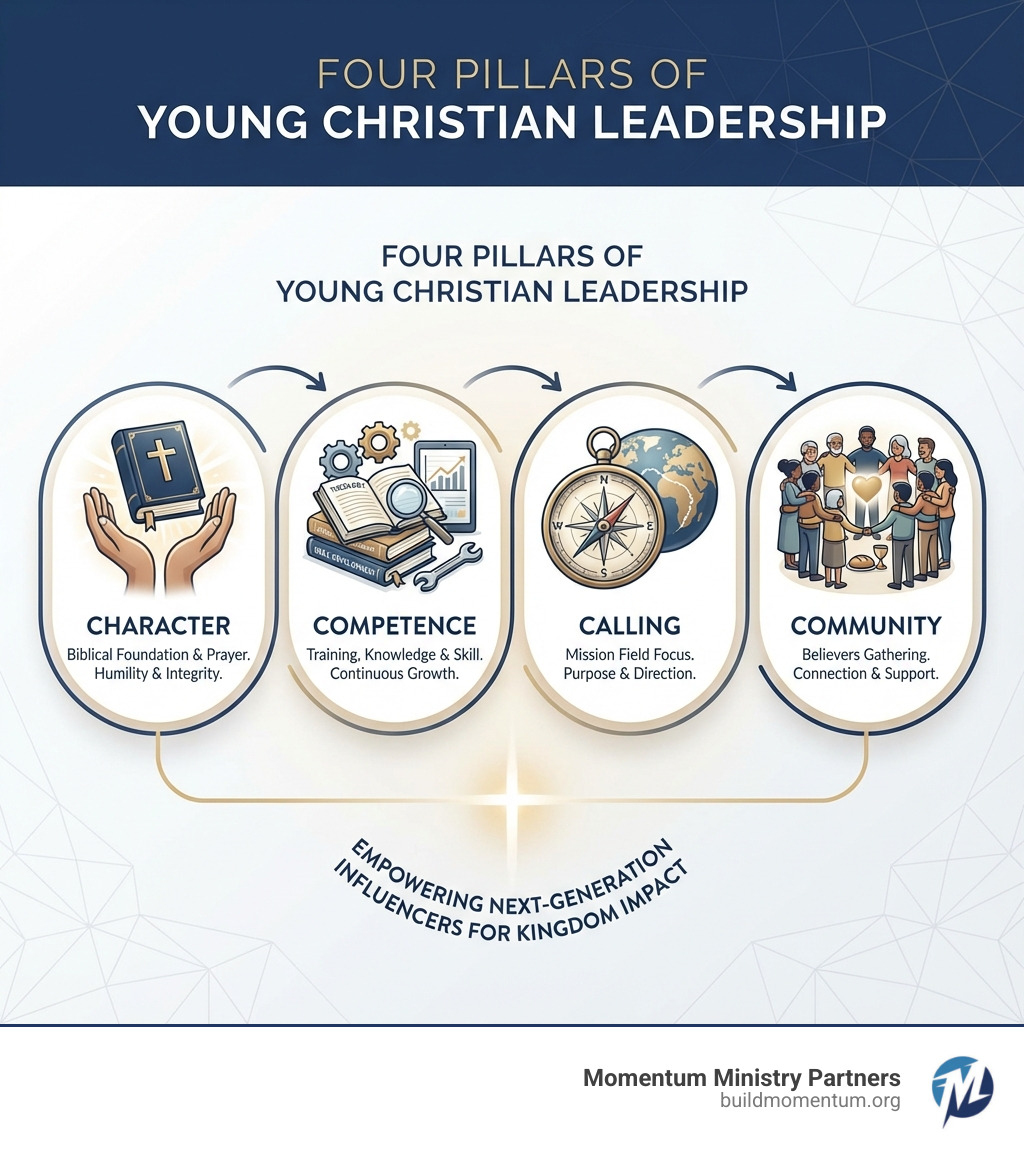
Pillar 1: Cultivating the Heart of a Leader
For any Christian leader, whether young or seasoned, the heart of their leadership begins not with strategy or skill, but with character. We believe that effective young Christian leaders are those whose inner lives reflect the qualities of Christ. This means focusing on humility, integrity, a teachable spirit, a deep passion for God, empathy for others, and above all, a servant’s heart. These are the foundational, internal qualities that define us and guide our actions in every aspect of ministry and life.

Young Christian leaders must remember that leadership in the Kingdom of God is fundamentally different from secular leadership. It is not about power or position, but about influence and service, modeled perfectly by Jesus Himself. As we strive to build Christian Character in young leaders, we are essentially helping them become more like Christ.
Essential Qualities of Young Christian Leaders
What truly sets apart a young Christian leader? It starts with a deep, personal relationship with Christ. This isn’t just a casual acquaintance; it’s a vibrant, daily walk that informs every decision and fuels every action. Without this foundation, even the most gifted individual will struggle to lead effectively in a Christian context.
Coupled with this relationship is strong Biblical literacy. We’re not talking about simply knowing Bible stories, but about understanding God’s Word, its theological truths, and how to apply it to life and ministry. The Bible is our ultimate guide, and a leader who knows and loves the Bible will lead with wisdom and conviction.
Beyond these spiritual anchors, young Christian leaders need resilience. The path of leadership is rarely smooth, especially in today’s world. There will be setbacks, criticisms, and moments of doubt. Resilience, rooted in faith, allows leaders to persevere through trials. They also need vision—the ability to see what God is doing and where He is leading, and to articulate that direction to others. Finally, the courage to be counter-cultural is paramount. In a world increasingly at odds with Christian values, young leaders must be bold enough to stand for truth, even when it’s unpopular. This courage is cultivated through a steadfast commitment to prayer and other spiritual disciplines, which are the lifeblood of any impactful Christian leader. These practices ensure our Personal and Spiritual Development remains vibrant and growing.
How to Maintain Your Faith and Calling
Leadership, particularly in Christian ministry, comes with immense pressures and demands. It’s easy to get caught up in the doing and lose sight of our being—our identity in Christ. This is why maintaining our faith and calling amidst these challenges is crucial for young Christian leaders.
One of the biggest dangers for young Christian leaders is burnout, especially when identity is tied to output instead of abiding in Christ. We’ve all seen it or experienced it ourselves. To avoid this, we must learn the importance of Sabbath—a rhythm of rest and spiritual renewal that God Himself instituted. It’s not a suggestion; it’s a command for our well-being and a testament to our trust in God’s sovereignty. Ignoring it is like trying to run a race without ever stopping for water. Our research shows that young Christian leaders need strategies to prevent burnout, and we explore these further in our article on Managing Pastor Burnout: Self-Care Strategies.
Additionally, finding a personal mentor is invaluable. This is someone who has walked the path before us, who can offer guidance, wisdom, and a listening ear. An accountability partner or group also provides a safe space to be vulnerable, confess struggles, and receive encouragement. Most importantly, we must stay grounded in Scripture. The Word of God is our anchor, our source of truth, and our comfort. Regularly immersing ourselves in it keeps our faith strong and our calling clear. As we often remind those we equip, continually be Feeding Your Soul: It Is Not As Easy As It Sounds (Pastorpedia). It’s not a one-time event but a continuous journey of drawing near to God.
Pillar 2: Navigating the Modern Leadership Gauntlet
The world we live in is constantly shifting, presenting young Christian leaders with a unique set of challenges that previous generations may not have encountered to the same degree. Today’s leadership gauntlet includes rapid cultural change, the complexities of a post-Christian society, the pervasive influence of the digital age, a growing mental health crisis among young people, and increasingly vocal social justice issues. Navigating these requires not just conviction, but also profound wisdom and discernment.

It’s a tricky landscape, and we often find ourselves wrestling with questions that don’t have easy answers. How do we engage with a culture that increasingly views Christian values as outdated or even harmful? How do we leverage technology for good without falling prey to its pitfalls? How do we address the real pain and injustice in the world while remaining faithful to the Biblical narrative? These are discussions we often dig into, especially when examining Christian Values Meet Culture: Youth Discussion.
Common Problems for Young Christian Leaders
The journey of a young Christian leader is not without its specific problems. One common problem is skepticism from older generations, who might view their ideas as too radical or their approach as too inexperienced. While wisdom from elders is vital, young leaders need space to innovate and lead. Conversely, young leaders often face a perceived or actual lack of experience, which can lead to self-doubt or being overlooked for significant roles.
Financial constraints can also be a significant barrier, particularly for those pursuing full-time ministry or launching new initiatives. The pressure to make ends meet can often compete with the demands of ministry. Furthermore, navigating divisive topics like politics and sexuality within the church and wider society presents a minefield of potential conflict. It’s a challenge to uphold Biblical truth with grace and love in an increasingly polarized world.
Perhaps the greatest tension is the pressure to be “relevant” versus remaining Biblically faithful. The world constantly screams for conformity, while the Gospel calls for change. Balancing these forces is a tightrope walk. We dig deeper into these specific issues in our article, Four Challenges Young Church Leaders Will Face. Understanding these challenges is the first step toward overcoming them and effectively Leading in a Changing Culture (Pastorpedia).
Leading with Wisdom in a Rapidly Changing World
In such a dynamic and often turbulent world, a firm Biblical worldview serves as the anchor for young Christian leaders. This worldview isn’t just a set of beliefs; it’s a lens through which we interpret every aspect of reality, guiding our responses to cultural shifts and societal pressures. It enables us to engage culture with both grace and truth, speaking God’s eternal Word into temporal situations. We must be quick to listen, slow to speak, and always rooted in love (James 1:19).
The digital age, while complex, also offers incredible opportunities for ministry. Young Christian leaders are often digital natives, adept at using technology for communication, community building, and spreading the Gospel. This includes leveraging social media, online platforms, and digital resources to reach wider audiences and foster discipleship. However, wisdom is needed to discern how to use these tools effectively and ethically.
Fostering unity in diversity is another crucial aspect of leading wisely. The Christian church is a global family, rich in cultural expressions and backgrounds. Learning to celebrate these differences while holding fast to core Biblical truths strengthens our collective witness. This is a key component of a robust Christian World View. Finally, addressing difficult questions with humility means acknowledging what we don’t know, being willing to learn, and always pointing back to the character of God. This approach allows us to steer sensitive subjects, even the Uncensored: Handling Difficult Topics in Youth Group, in a way that honors God and edifies His people.
Pillar 3: The Church’s Role in Raising Up Young Christian Leaders
We believe that developing young Christian leaders is not just an individual pursuit but a sacred responsibility of the entire church. Established leaders and congregations play a pivotal role in identifying, nurturing, and empowering the next generation. It’s about more than just finding someone to fill a spot; it’s about intentionally cultivating potential and preparing them for a lifetime of faithful service.
Our calling is to create an environment where young people can transition From Followers to Leaders: Fostering Young Christian Leadership. This means actively looking for potential, creating real opportunities for them to serve, and providing genuine apprenticeship experiences. It also means empowering them with increasing levels of authority and responsibility, trusting them to lead.
Identifying and Mentoring the Next Generation
Identifying potential young Christian leaders requires a discerning eye, looking beyond charisma to the deeper qualities of faithfulness and potential. We often refer to the F.A.T. principle: Faithful, Available, Teachable. These are the core attributes that indicate a young person is ready for leadership development. Faithfulness demonstrates commitment and reliability; availability shows a willingness to serve; and teachability reveals an open heart eager to grow.
Creating a culture of discipleship within the church is paramount. This is a context where spiritual growth is prioritized, and mentorship relationships naturally flourish. It’s about helping young people understand what it truly means to follow Christ and then to lead others in that journey. We’ve seen how crucial this is when we share 3 Things You Must Do to Raise Up Student Leaders.
The value of intergenerational collaboration cannot be overstated. When seasoned leaders invest in younger ones, and young leaders respect the wisdom of those who have gone before, a powerful synergy emerges. This creates a rich environment for Christian Leadership Mentoring the Next Generation. Mentorship, particularly in local church settings, provides personalized guidance, practical wisdom, and a safe space for growth and learning. It’s here that young leaders can ask tough questions, process challenges, and receive encouragement custom to their unique journey.
Empowering Youth with Real Responsibility
One of the most impactful ways churches can raise up young Christian leaders is by moving them beyond token roles and entrusting them with real responsibility. It’s not enough to give them busywork; we need to give them meaningful tasks that contribute to the church’s mission. This might mean granting them access to leadership meetings, allowing them to observe decision-making processes, and inviting their input. This is not about being busy, but about equipping them to fulfill their God-given callings.
A crucial aspect of empowerment is allowing room for failure and grace. Young Christian leaders will make mistakes—it’s part of the learning process. Instead of reprimanding them, we should offer grace, provide constructive coaching, and help them learn from their missteps. This creates a safe environment for growth and risk-taking. Just like any good coach, we need to offer feedback that builds up, not tears down.
Delegating significant tasks, leading teams, and even overseeing projects, demonstrates trust and builds confidence. When young leaders see their contributions valued and celebrated, they are more likely to step up and accept greater responsibility. This intentional empowerment truly helps in Unlocking Team Potential: The Power of Youth Leaders within our churches and communities.
Pillar 4: Equipping for Impact Through Training and Education
To truly make a lasting impact, young Christian leaders require more than just a willing heart; they need to be thoroughly equipped. This involves a blend of formal education and practical, hands-on training that prepares them for the complexities of ministry and leadership in the modern world. It’s a continuous journey of learning and applying, ensuring they are ready for whatever God calls them to do.
Whether it’s through structured theological education or experiential learning, the goal is always the same: to develop competent, confident, and Christ-centered leaders. We understand the importance of diverse approaches to learning, and our Training Experiences are designed to facilitate this. This commitment to lifelong learning ensures that young leaders are always growing, adapting, and sharpening their skills for greater effectiveness in God’s Kingdom.
The Role of Theological and Practical Training
A solid Biblical foundation is non-negotiable for young Christian leaders. This means more than surface-level knowledge; it involves deep dives into Scripture, understanding church history, and struggling with Christian doctrine. Theological education provides the framework for interpreting God’s Word accurately, developing a robust worldview, and articulating the Gospel clearly. It equips leaders to steer complex ethical issues and defend their faith with intellectual integrity.
Alongside theological depth, practical ministry skills are essential. This includes everything from effective preaching and teaching, to compassionate counseling, efficient administration, and strategic planning. The balance between “knowing” and “doing” is crucial. A leader might have immense theological knowledge but struggle to apply it in real-world ministry settings without practical training. Conversely, a leader with great practical skills but shallow theological roots risks leading people astray.
The goal is to integrate these two aspects, allowing theological understanding to inform practical action, and practical experience to deepen theological reflection. This holistic approach ensures that young Christian leaders develop into well-rounded, effective servants of Christ. Our Christian Education Resources are designed to support this integrated learning, providing tools for building strong Biblical understanding and practical ministry expertise.
Resources and Opportunities for Growth
We are passionate about ensuring that young Christian leaders have access to the resources and opportunities they need to grow. This includes a variety of pathways for development, recognizing that each individual’s journey is unique.
One significant area of support is accessible training pathways that combine theology, mentoring, and real ministry practice. Various scholarships and grants are often available through Christian organizations and foundations to help students pursue undergraduate or graduate-level degrees, removing barriers so aspiring leaders can pursue long-term formation with consistency. These opportunities can be instrumental in equipping them for global impact. Additionally, some educational institutions partner with ministry programs to offer academic credit for hands-on training, blending formal education with practical experience.
Beyond formal education, internships and residencies offer invaluable hands-on experience, allowing young leaders to learn by doing under the guidance of experienced mentors. Denominational training programs also provide custom instruction relevant to specific ministry contexts. For ongoing learning, there’s a wealth of knowledge in books and podcasts on Christian leadership, covering everything from spiritual formation to practical ministry strategies. For those looking to deepen their understanding of how to lead and serve the next generation, we encourage you to Learn more about developing leaders in Youth Ministry. These diverse opportunities ensure that every young Christian leader can find a path to continuous growth and impact.
The Future is Now: The Hope for Young Christian Leadership
The future for young Christian leaders is not merely promising; it is now. We stand on the precipice of a new era, where the energy, vision, and conviction of this generation are ready to make an indelible mark on both the church and society. We believe in their immense potential to impact the world for Christ, driving forward the Great Commission with fresh zeal and innovative approaches.
We see the hope for a new “great awakening,” echoing the historical movements where young, passionate believers ignited spiritual renewal. The Lausanne Movement reminds us that many global leaders today, like Ramez Atallah, Ajith Fernando, and John Piper, engaged in significant leadership roles in their 20s and 30s. This isn’t a new phenomenon, but a timeless pattern of God raising up the next generation.
Young Christian leaders bring unique insights into contemporary culture, leveraging technology and new forms of communication to spread the Gospel in ways that resonate with their peers. They are often at the forefront of addressing complex social issues, demonstrating Christ’s love and justice in tangible ways within their communities, from Philadelphia to Los Angeles, Akron to Phoenix AZ.
At Momentum Ministry Partners, we are deeply committed to equipping these emerging leaders. We recognize that our responsibility is not just to maintain the church, but to propel it forward through the hands of the next generation. Our conferences, ministry degrees, resources, and mentoring programs are all designed to provide life-changing experiences and practical leadership training that empowers young Christian leaders to be Christ-like, Christ-following, and Christ-serving influencers in every sphere of society.
The ongoing call to invest in the next generation is not merely a strategy; it is a Biblical imperative. As we identify, mentor, and empower these young Christian leaders, we are participating in God’s unfolding plan to transform the world. Let us accept this sacred responsibility with enthusiasm, for the future of the church and the impact of the Gospel depend on it.
Bring your students to the Momentum Youth Conference and help form young Christian leaders who become the next generation of Christian leaders in your church through worship, teaching, and hands-on ministry.






0 Comments