

Why Every Church Needs a Clear Ministry Strategy
Ministry strategy is the intentional plan for how your church will accomplish its God-given mission. It’s not about replacing faith with business thinking—it’s about being a faithful steward of the resources, people, and opportunities God has placed in your care. A clear strategy provides mission clarity, guides resource allocation, forces strategic choices, sets actionable goals, and builds in adaptability.
For many ministry leaders, the term ‘strategy’ can sound corporate, but a ministry strategy is simply faithful stewardship with clarity. But the Bible is filled with examples of faithful planning. Proverbs 16:3 reminds us: “Commit your works to the Lord and your plans will be established.” A ministry strategy doesn’t replace spirituality; it expresses it through faithful stewardship
Without a clear ministry strategy, ministries often drift—reacting to crises instead of leading with purpose. Leaders burn out, resources get scattered, and the urgent crowds out the important. But with a thoughtful, prayerful strategy, you can lead with confidence, focus your team’s energy, and measure what truly matters—transformed lives.
I’m Jeff Bogue. After three decades in pastoral leadership, I’ve seen a clear ministry strategy move churches from scattered activity to focused, disciple-making impact.
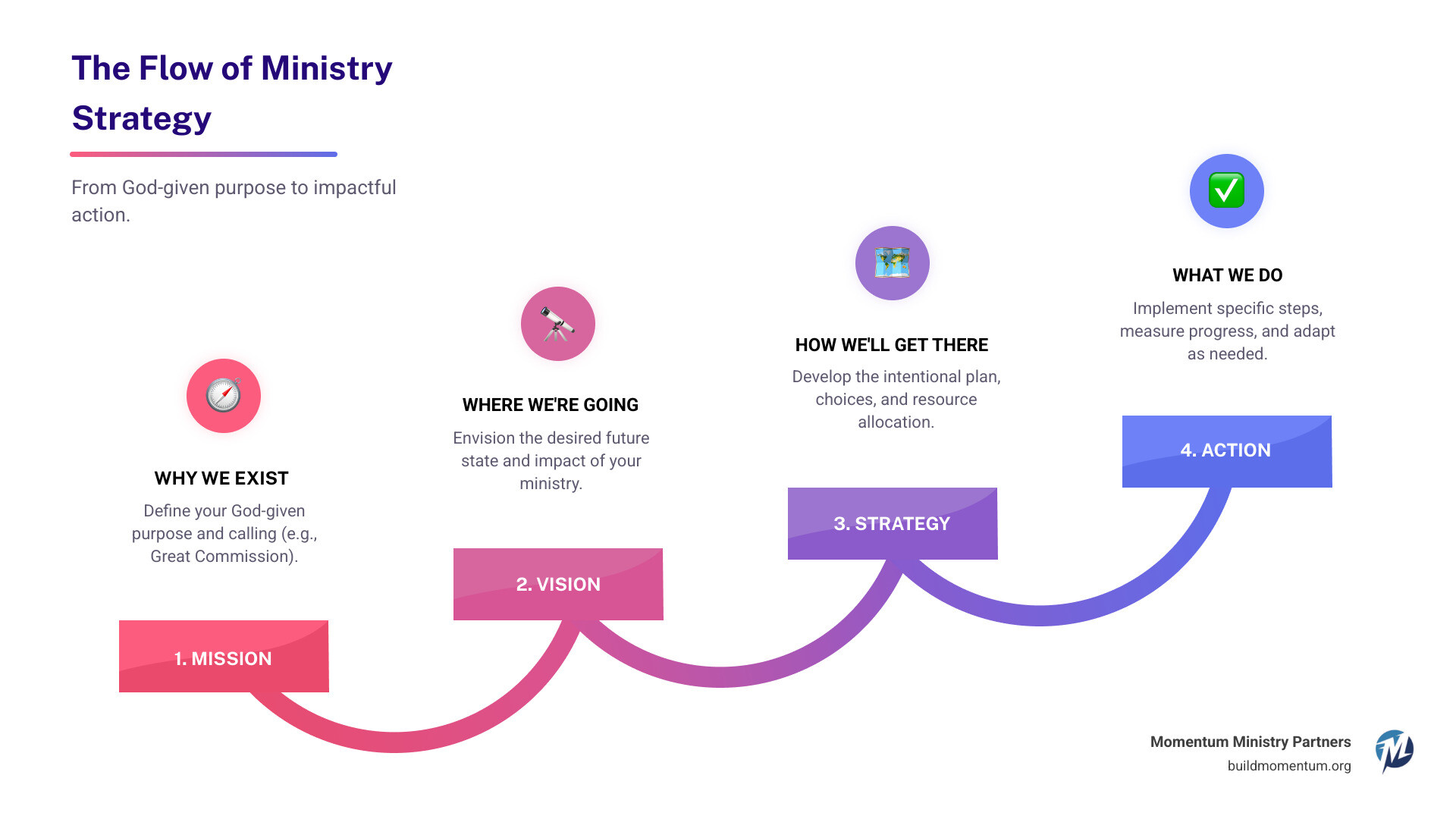
The ‘Why’ and ‘What’ of Ministry: From Mission to Strategy
Before diving into the “how” of ministry strategy, we must grasp the “why” and “what” of our calling. Our mission is our North Star, the divine purpose that guides every decision. Strategy is the map that helps us steer toward that star.
Clarifying Your God-Given Mission
At the heart of every effective ministry strategy lies a clear mission that answers: “Why do we exist?” For Christian ministries, our ultimate mission flows from the Great Commission in Matthew 28:19-20 to “go and make disciples of all nations.” This Biblical mandate is our core purpose. A clear mission statement, like “Love God. Love people. Make disciples of Jesus Christ,” acts as a filter for all strategic decisions, ensuring every activity has purpose and direction. To clarify our calling, we often refer to The Gospel and Our Part in Clarifying and Calling – Pastorpedia for guidance.
The Biblical Foundation for Your Ministry Strategy
Some may find ‘strategy’ unspiritual, but a Biblical ministry strategy is prayerful wisdom applied to God’s mission. Our approach is not about replacing faith with human ingenuity, but about prayerfully applying wisdom to the work God has entrusted to us.
- In Genesis 41, Joseph developed a 14-year anti-starvation plan for Egypt.
- In Nehemiah 2, Nehemiah carefully assessed Jerusalem’s walls, secured resources, and organized the people with remarkable foresight.
- Jesus Himself modeled a profound ministry strategy. He spent three years in intensive discipleship with twelve men, training leaders who would carry on His mission.
- The Apostle Paul echoed this in Ephesians 4:12, stating the minister’s job is “to equip the saints for the work of ministry.”
These examples aren’t faithless pragmatism; they show ministry strategy as faithful stewardship.
Explaining the Key Components of Strategy
Simply put, ministry strategy is the ‘how’ your mission is accomplished. It’s the practical bridge between where you are now and where God is calling you to be. It involves two key components:
- Resource Allocation: Every ministry has limited time, capacity, and people. A strategy involves making conscious decisions about where to invest these resources for maximum impact.
- Making Choices: Strategy requires making trade-offs. We cannot be everything to everyone. Deciding to focus on children’s ministry over another program is a strategic choice that defines your ministry’s true priorities.
Leaders often find that a clear ministry strategy brings focus, alignment, and healthier decisions over time. This reinforces that thoughtful planning creates a framework where spiritual growth can flourish. Understanding these strategic choices can be further explored in Confusion About Groups in the Church.
Integrating Spiritual and Strategic Leadership

Many leaders worry a ministry strategy might quench the Spirit, prioritizing human logic over divine leading. However, the opposite is true. Integrating spiritual and strategic leadership is a deeply spiritual process that relies on God’s guidance to steward His resources for His glory.
The Harmony of Prayer and Planning
In every ministry strategy, spiritual leadership must come first. Our ultimate direction comes from God through His Word and the Holy Spirit. Strategy is a powerful tool in the hands of Spirit-led leaders. We must integrate prayer into every step of the planning process, starting by asking, “What does God want to do through us?” Prayer is not a formality; it is the foundational work that empowers all planning. You can dig deeper into this practice with Prayer: How to Teach & Model – Pastorpedia.
Fostering a Culture of Strategic Thinking
A healthy strategic process fosters a culture of strategic thinking. This means equipping your team to understand the “why” behind their work, moving from a reactive to a proactive mindset. When leaders understand the overall ministry strategy, they take shared ownership of the mission, leading to greater buy-in and more effective implementation. This requires open dialogue, regular evaluation, and building strong leaders, as highlighted in Pastorpedia: Developing Leadership in the Church. Working effectively with your governing body, as detailed in Working With Healthy Church Boards, also ensures strategic efforts are supported at all levels.
Building Your Annual Ministry Strategy: A Practical Framework

With a solid foundation in place, it’s time to build a practical ministry strategy for the year ahead. This framework provides a step-by-step guide to setting clear, purposeful goals for the upcoming year that are deeply rooted in your mission and focused on what matters most: people.
Step 1: Define Your Focus—People Over Programs
Jesus’ model of discipleship focused on people, not programs. He invested deeply in twelve individuals. Similarly, the Apostle Paul’s “crown of boasting” was the people he discipled (1 Thessalonians 2:19-20). This leads to a critical question for our ministry strategy: “What kind of people are we developing?” Not just, “how many people are here?” Our goal is to move individuals from being spiritual consumers to contributors. This shift is essential, as discussed in From Consumers to Contributors: Empowering Youth in Worship. This requires clarity about who we are trying to reach, which helps focus our resources for the greatest impact. For insights on raising up the next generation, see 3 Things You MUST Do to Raise Up Student Leaders.
Step 2: Set Purposeful Goals Across Key Ministry Areas
Clear goals keep your ministry strategy focused on your mission. These goals should cover the essential areas of a healthy ministry, ensuring your strategy is comprehensive and balanced. Consider setting goals in these areas:
- Spiritual Growth: Fostering discipleship, Bible study, and prayer. See The Basics of Spiritual Growth in Students.
- Outreach & Evangelism: Engaging the local community and equipping members to share their faith. Our Evangelism Training can help.
- Community & Fellowship: Building strong relationships through small groups and mentorship. Learn more about Building Christian Community.
- Leadership Development: Identifying, training, and empowering new leaders and volunteers. Find 4 Essentials to Recruiting Committed Volunteers.
- Stewardship & Sustainability: Practicing Biblical stewardship and aligning resources with mission.
- Technology & Innovation: Leveraging technology for outreach, discipleship, and communication.
- Adaptability & Responsiveness: Building flexibility to respond to the Holy Spirit and changing needs.
Step 3: Create Your Actionable Ministry Strategy
Once goals are set, formulate the actionable ministry strategy—the “how.” This involves creating a concrete 12- to 24-month plan that identifies initiatives that advance your mission most effectively. A best practice for goal setting is to use the SMART criteria:
- Specific: Clearly defined.
- Measurable: Quantifiable to track progress.
- Achievable: Realistic and attainable.
- Relevant: Aligned with your mission.
- Time-bound: Has a clear deadline.
For example, within your ministry strategy, a SMART goal could be: ‘Identify and train new small group leaders by the end of Q3.’ Linking strategic goals with a missional context is crucial, as explored in How to Set Missional Goals in a Ministry Context – A Digital Lab. Effective time management is also key, as discussed in Pastorpedia: Personal Time Management for a Pastor.
Executing and Adapting Your Strategy for Lasting Impact
A ministry strategy on paper is only a dream. The real work begins in execution, evaluation, and adaptation. A living strategy is one that can be measured and refined as we respond to the Holy Spirit and the changing needs of our community.
Measuring What Matters
How do we know if our strategy is working? We measure what matters. This goes beyond tracking attendance and focuses on discipleship depth, engagement, and leadership development. We need more nuanced metrics of engagement and impact. Everything we measure should help us make better decisions. This includes gauging spiritual growth (are people moving from consumers to contributors?), evaluating outreach effectiveness, and tracking community engagement. Regularly reviewing these metrics helps us assess our effectiveness and ensures our goals are aligned with God’s vision. For a deeper look, explore How Should a Church Assess Its Effectiveness? – Pastorpedia.
The Role of Technology and Adaptability
We’re living through a major communication shift, and digital ministry can’t be an afterthought. Digital ministry is no longer an add-on; it must be an embedded part of our overall ministry strategy. Our goal is to reach people where they are, which means leveraging technology for connecting, discipling, and engaging our communities online. Technology can remove friction and help people respond consistently to vision and stewardship. Most importantly, our strategy must be adaptable. The world is constantly shifting, and the Holy Spirit is always at work. We must build flexibility into our plans to pivot when necessary, whether in response to community feedback or larger cultural changes, as discussed in Pastorpedia: Leading in a Changing Culture.
Frequently Asked Questions about Ministry Strategy
How is a ministry strategy different from a vision statement?
A vision statement is the “where”—the desired future (e.g., “To see every student passionately pursuing Jesus.”). A ministry strategy is the “how”—the broad plan and set of choices that bridge the gap between your current reality and your future vision.
Our church is small. Do we still need a formal strategy?
Absolutely. Strategy isn’t about complexity; it’s about wise stewardship. For a small church, a ministry strategy ensures your limited time, energy, and finances are focused on the most impactful activities that align with your mission, preventing burnout and maximizing fruitfulness.
How often should we review and update our ministry strategy?
A good ministry strategy is a living document. Conduct a major review annually before budget and calendar planning. Additionally, hold quarterly check-ins with your leadership team to evaluate progress, celebrate wins, and make adjustments. This ensures your strategy remains relevant and responsive.
Conclusion
Developing a ministry strategy is not a departure from faith; it is an act of faith. It is the spiritual discipline of prayerfully stewarding the people, resources, and mission God has entrusted to you. By integrating prayer with planning and building a clear path forward, you can lead your ministry with greater purpose and impact. At Momentum Ministry Partners, we equip leaders to clarify and execute a healthy ministry strategy without losing the spiritual center. To continue learning, we invite you to explore our resources for youth ministry.
If your ministry strategy feels unclear or hard to execute, you don’t have to figure it out alone. Contact us to talk through your current reality and identify the clearest, healthiest next steps.






0 Comments