

Why Emerging Church Leaders Matter More Than Ever
Emerging church leaders are young adults and new leaders being equipped as the next generation of Christian leaders for a rapidly changing world. They face unique challenges, including cultural skepticism, digital saturation, and a search for authentic faith. Here’s what you need to know:
Key Characteristics of Emerging Church Leaders:
- Age Range: Typically 21-27 years old, though can include anyone new to ministry leadership
- Core Focus: Balancing Biblical truth with cultural relevance
- Ministry Approach: Emphasizes authentic community, missional living, and relational discipleship
- Theological Stance: Ranges from evangelical to more progressive perspectives, though faithful leaders maintain core Biblical doctrines
- Leadership Style: Values transparency, dialogue, and empowering others over hierarchical control
What They’re Navigating:
- Postmodern skepticism about absolute truth
- Declining trust in religious institutions
- Desire for experience-based faith over propositional teaching alone
- Digital connectivity and global awareness
- Social justice concerns and holistic Gospel application
The Church is at a critical crossroads. We’re not just experiencing a generational transition—we’re witnessing a fundamental cultural shift that requires leaders who can faithfully communicate timeless truth in new ways. The question isn’t whether the next generation will lead, but how we will equip them.
I’m Jeff Bogue, and over three decades in ministry—including leading a multi-campus church and now serving as President of Momentum Ministry Partners—I’ve made it my mission to invest in emerging church leaders who will carry the Gospel forward with both conviction and compassion. Through initiatives like Momentum Youth Conference and Momentum PRO, we’ve seen how proper training and mentorship transform passionate young believers into effective, faithful leaders.
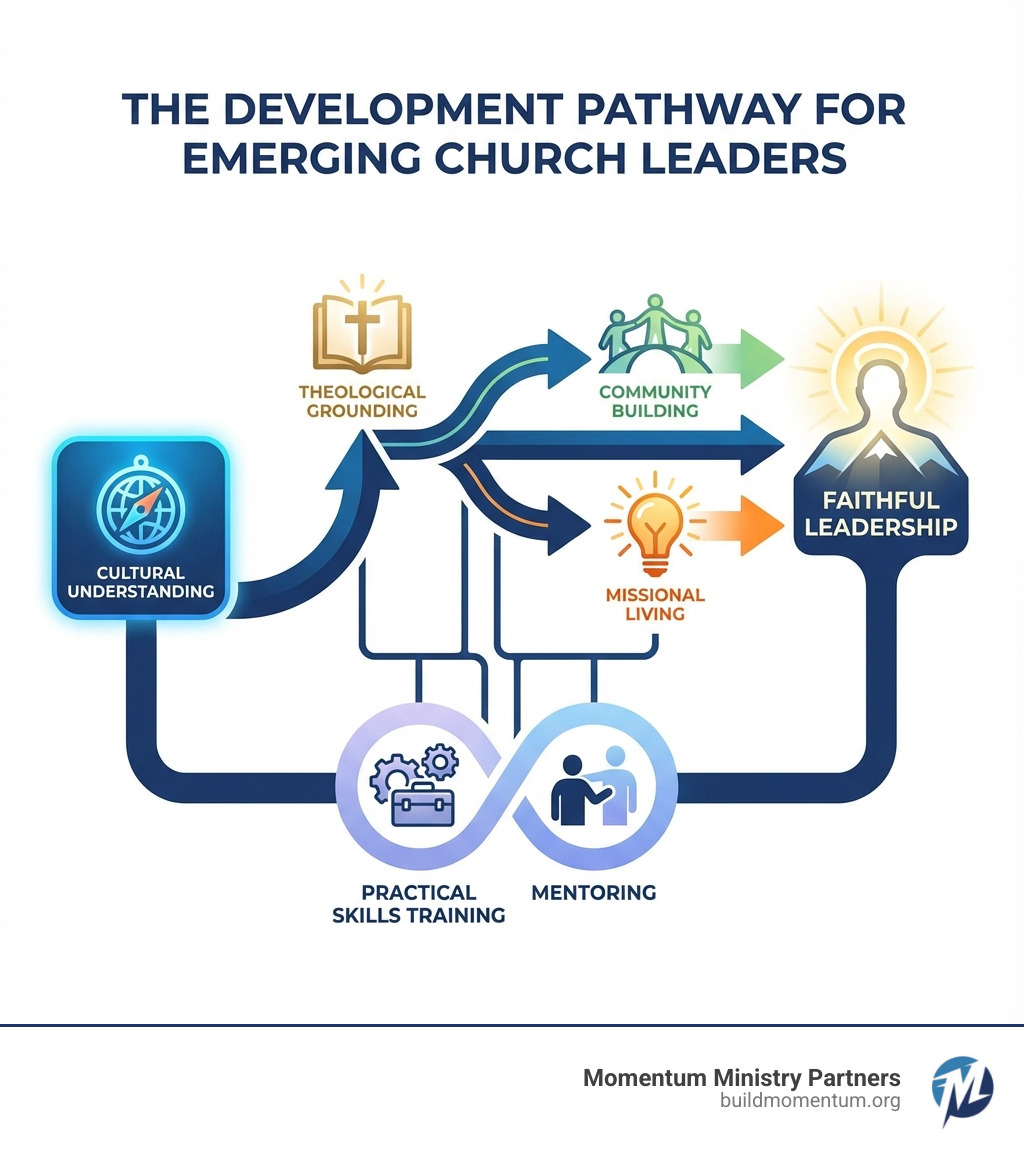
1. Understand the Cultural Context They Inhabit
A leader who does not understand the world their people live in cannot lead them effectively. Today’s emerging leaders are navigating a world shaped by rapid technological change, digital saturation, and global connectivity.
This cultural context is often characterized by:
- A Search for Authenticity: Young generations are skeptical of polished, corporate-style presentations. They crave genuine relationships and transparent leadership.
- Skepticism of Institutions: Trust in large institutions, including the Church, is at an all-time low. Leaders must earn trust through character and consistency, not rely on a title.
- Experience over Explanation: While truth is paramount, many people today connect with faith through shared experiences, community, and seeing the Gospel lived out before they fully accept its theological propositions.
To effectively develop emerging leaders in the church, we must first listen. We need to understand their questions, doubts, and aspirations. This means engaging with the realities of their world, including the difficult questions surrounding Gen Z & Religion and other disturbing cultural trends. The goal is not to conform the Gospel to the culture, but to communicate its timeless truth in a way that can be clearly understood and received. We cannot disciple leaders for a world that no longer exists; we must equip them for the one they actually inhabit.
Emerging church leaders felt a profound call to address this changing landscape. They recognized that the world had changed, and that traditional church models, often rooted in modernism, were struggling to connect with younger generations, particularly Gen-Xers and Millennials.
The implications of this response are significant. It highlighted the need for the Church to adapt its methods without compromising its message. Leaders realized that a new paradigm for church affiliation was emerging, shifting from “behave, believe, then belong” to “belong, believe, then behave.” This means fostering community and relationship first, allowing individuals to experience belonging before fully embracing specific beliefs or behaviors. Understanding this cultural shift is paramount for any emerging church leader today.
2. Ground Them in Timeless Theological Truth

While culture changes, the Word of God does not. One of the most important lessons from church history is that innovation in ministry must never come at the expense of the Gospel. Theological drift can undermine the very foundation of Christian leadership.
Therefore, building emerging church leaders requires a relentless commitment to deep theological grounding. This includes:
- The Authority of the Bible: Instilling a deep conviction that the Bible is the inspired, inerrant, and sufficient Word of God.
- Gospel Clarity: Ensuring a firm grasp on the Gospel message—that salvation is by grace alone, through faith alone, in Christ alone.
- Doctrinal Fidelity: Training them in the essential, non-negotiable doctrines of the Christian faith, such as the Trinity, the full deity and humanity of Christ, and His substitutionary atonement.
This grounding is the anchor that keeps leaders from being “tossed back and forth by the waves, and blown here and there by every wind of teaching” (Ephesians 4:14). It forms the basics of spiritual growth in students and provides the foundation for a lifetime of faithful ministry. Robust historical theology, such as that from the Reformation, offers powerful and relevant answers to postmodern questions. A deep engagement with church history and theology reveals that we are not the first generation to face these challenges. True Christian leadership mentoring must be deeply and unashamedly rooted in the eternal truth of Scripture.
For example, while the Bible’s authority is foundational for traditional evangelicals, some emerging church leaders have proposed a “hermeneutics of humility” where truth is found through dialogue and experience rather than being solely derived from propositional statements in Scripture. This approach has led to concerns about theological orthodoxy and Biblical interpretation. When concepts like salvation, the Gospel, and the authority of Scripture are redefined or questioned, it creates concerns about the very foundation of Christian faith.
3. Champion Both Authentic Community and Missional Living

One of the most positive and enduring legacies of recent church conversations has been the emphasis on authentic community and missional living. Many leaders have observed that the modern church can become too focused on Sunday morning programs and lose its sense of being a family on a mission.
In many contexts, leaders are rediscovering the importance of belonging and relationships as a bridge to belief and obedience. In a lonely and fragmented world, people are desperately searching for a place to belong. The Church should be that place, a welcoming, authentic community where people can be known and loved. It is within the context of these relationships that they can encounter the love of Christ, come to believe in Him, and learn to live a new life of obedience.
This community is not meant to be an end in itself. It is the base of operations for missional living. This means seeing all of life as an opportunity to join God in His redemptive work in the world. It’s about being the hands and feet of Jesus in our neighborhoods, workplaces, and cities. This involves:
- Incarnational Ministry: Not just inviting people to church, but going out to be the church among them.
- Holistic Gospel: Understanding that the Gospel is good news for the whole person—spirit, soul, and body—and for all of creation.
- Social Justice: Caring for the poor, the marginalized, and the oppressed as a direct outworking of our love for God and neighbor.
This is what it means to be Salt & Light in the world. When we equip emerging church leaders to build these kinds of communities, the Gospel becomes plausible. People see the truth of Christ’s love demonstrated in tangible ways, from community service and spiritual growth projects to simple acts of hospitality.
The emphasis on authentic community and missional living represents one of the significant benefits of the Emerging Church movement for contemporary Christianity. It challenges traditional models that may have become overly program-driven or inwardly focused, urging Christians to engage with their local contexts and demonstrate the Gospel through tangible acts of love and service. This aligns with the desire of many emerging church leaders to move beyond a “Christendom” mentality – where the Church holds cultural power – to a “post-Christendom” approach where the Church serves from the margins.
Leaders like Mark Scandrette (California) and John Burke have championed these ideas, focusing on how believers can live out their faith in everyday life, changing their communities. This approach often leads to a focus on social action, community involvement, and global justice issues, which are seen as practical manifestations of God’s Kingdom on earth. This holistic view of the Gospel, which cares for both spiritual and physical needs, resonates deeply with younger generations who are passionate about making a difference in the world.
4. Equip Today’s Emerging Church Leaders with Practical Skills
Theological knowledge and a missional heart are essential, but they must be paired with the practical skills needed to lead effectively in the 21st century. Leadership is a craft that must be learned and honed.
Fostering Essential Leadership Qualities
Before a leader can lead others, they must learn to lead themselves. This involves cultivating character and personal discipline. We must train emerging church leaders in areas like time management, emotional health, and personal holiness. They need to understand the importance of integrity in business and all areas of life, and they need practical strategies for balancing ministry and family. A leader’s public ministry will only be as healthy as their private life.
Research into effective Christian leaders, often called “movement catalysts,” reveals specific qualities that temper charisma and ensure sustained impact. While charisma is often present in fruitful leaders, it must be complemented by:
- Spiritual Disciplines: Extensive prayer and “listening to God” act as an antidote to ego and cultivate dependence on the Holy Spirit.
- Conscientiousness: This trait prevents impulsive actions and prioritizes achievement, ensuring leaders are disciplined and focused.
- Agreeableness: This fosters social harmony and prevents leaders from dominating others, promoting a genuine love for people.
- Commitment to Empower Others: Effective emerging church leaders intentionally relinquish control and hand off responsibilities, even risking failure, to raise up more leaders.
These guardrails help emerging church leaders multiply disciples and lead sustainably over time, whether in urban centers like Philadelphia or Los Angeles, or in smaller communities across Ohio, Indiana, and Pennsylvania.
Navigating Different Ministry Approaches
There is no one-size-fits-all model for church leadership. Today’s emerging church leaders need to be familiar with different youth ministry strategies and church models to find the approach that best fits their context and calling. This includes understanding the nuances of various church structures and how to lead within or adapt them.
| Ministry Model | Primary Focus | Evangelism Style | Discipleship Method |
|---|---|---|---|
| Attractional | Excellent Sunday services and programs | Inviting people to events | Classes and small groups |
| Missional | Equipping people for ministry in daily life | Relational, incarnational | Life-on-life mentoring |
| House Church | Simple, reproducible community | Organic, through relationships | Communal living and practice |
The emergence of microchurch movements, for example, represents a significant shift from the “launch large” model of church planting. Leaders like Dan Kimball (California), Rob Bell, and Doug Pagitt have been influential in exploring diverse forms of worship and community, from alternative music styles to the revival of ancient practices. Others, such as Dallas Willard (University of Southern California), have influenced spiritual formation within the movement. Understanding these various “lanes” and the leaders associated with them allows emerging church leaders to discern which approaches align best with Biblical principles and their specific calling.
The future trajectory of the Emerging Church movement will likely continue to influence broader Christian thought and practice by emphasizing contextualization, authentic community, and missional engagement. However, the critical evaluation of its theological stances, particularly concerning Biblical authority and core doctrines, remains crucial for ensuring its long-term faithfulness.
Mentoring the Next Generation of Emerging Church Leaders
Leadership is best learned through apprenticeship. Jesus didn’t give His disciples a textbook; He invited them to follow Him. The most effective way to build the next generation of emerging church leaders is through intentional, relational investment. This involves creating robust student leader training programs and fostering a culture of Christian mentoring where experienced leaders pour their lives into younger ones. This life-on-life discipleship is the engine of leadership development.
Immersive environments can accelerate formation by combining theology, practice, and mentoring; this is exactly what many emerging church leaders need. Such immersive experiences, coupled with academic partnerships with institutions like Dallas Baptist University, Dallas Theological Seminary, and Wesley Seminary, provide a holistic approach to equipping future leaders. The goal is to develop leaders who embody “a faith worth following” and are prepared for a lifetime of good works, whether in a large church in Akron or a new microchurch in Goshen, Indiana.
Frequently Asked Questions about Emerging Church Leadership
What is meant by “emerging church leaders”?
Emerging church leaders are individuals—often younger adults or those new to leadership—who are being equipped to guide the Church in a rapidly changing cultural context. They are characterized by a passion for Biblical truth, a heart for authentic community, and a commitment to missional living. They include a diverse group of individuals, from those leading traditional evangelical churches to those exploring alternative church models. Prominent figures who have been associated with the broader movement include Brian McLaren, Rob Bell, Doug Pagitt, Dan Kimball, Tony Jones, and Mark Scandrette.
What are the main challenges facing emerging church leaders today?
Emerging church leaders face challenges such as cultural skepticism toward institutions, the need for authentic relationships, and the pressure to adapt to new technologies and communication styles. They must also steer the tension between cultural relevance and Biblical faithfulness, ensuring that innovation in ministry does not lead to theological compromise or an abandonment of core Christian doctrines. Navigating diverse theological viewpoints within the broader movement, from evangelical to more liberal expressions, also presents a significant challenge.
How can churches best support the development of emerging leaders?
Churches can support emerging church leaders by providing intentional mentoring, robust theological training that grounds them in Biblical truth, opportunities for hands-on ministry, and a supportive community that values their contributions. This includes encouraging self-leadership, developing practical ministry skills, and fostering an environment where they can explore different ministry approaches. Resources like Momentum Ministry Partners’ leadership development programs are designed to help churches invest in the next generation.
Conclusion: The Future is in Good Hands
Building the next generation of leaders is not about replicating the past. It is about faithfully applying timeless Biblical truth to new and challenging contexts. The history of church leadership provides both inspiration and caution. It inspires us to engage our culture with creativity and courage, and it cautions us to hold fast to the unchanging Gospel of Jesus Christ.
By understanding the culture, grounding leaders in deep theological truth, championing authentic community, and equipping them with practical skills, we can confidently empower the leaders who will guide the Church into the future. Momentum Ministry Partners is dedicated to this very task, partnering with local churches to provide the resources and training needed to develop leaders for a lifetime of faithful service. The future of the Church is in God’s hands, and He is raising up a new generation to lead it.
Ready to invest in emerging church leaders and form the next generation of Christian leaders in your youth ministry? Bring your students to the Momentum Youth Conference for life-changing sessions, hands-on ministry, and training designed to accelerate spiritual momentum.





0 Comments