

You Are Not Alone in the Valley
When you’re walking through the valley of depression, it can feel like you’re completely alone. The weight of despair can be crushing, making it hard to see any light. But there is hope. The Bible is filled with powerful Scripture for depression that offers comfort, strength, and the unwavering promise of God’s presence.
Depression is a real and common struggle, affecting millions of people, including those of strong faith. Throughout history, even great Biblical figures like Moses, David, and Elijah faced profound despair. Their stories are not tales of weak faith, but of human struggle met by a faithful God. The Bible doesn’t use the word “depression,” but it speaks directly to the feelings of hopelessness, sorrow, and a crushed spirit. It offers a unique comfort: the assurance that God is with you in your darkest moments.
God invites you to bring your brokenness to Him. He promises to be near to the brokenhearted and to save those who are crushed in spirit (Psalm 34:18). This isn’t about “snapping out of it,” but about finding strength in a source greater than yourself. At Momentum Ministry Partners, we’ve seen countless individuals find that Scripture becomes an anchor in the storm, providing a foundation of truth when feelings are overwhelming.
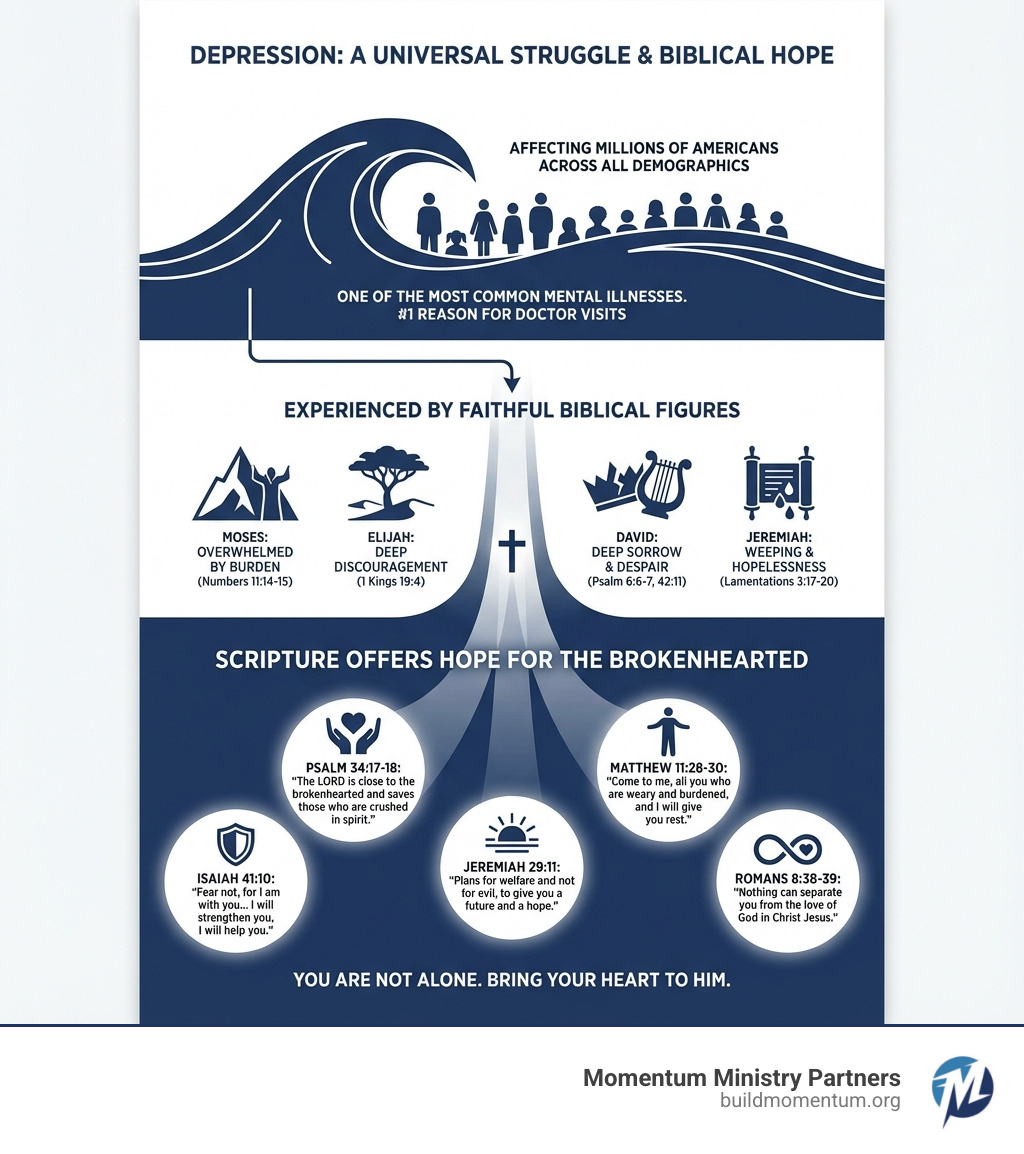
What the Bible Says About Despair and Hope
While “depression” is a modern term, the Bible is filled with raw, honest accounts of deep sorrow and despair. It shows that even the most faithful people wrestled with overwhelming emotions. This is a comfort, reminding us that our struggles are not new and we are not alone. The Bible provides both a language for our pain and a promise of God’s presence within it.

Biblical Heroes Who Cried Out to God
Many of the Bible’s heroes experienced profound despair, yet their stories are recorded to give us hope.
- Moses: Overwhelmed by the burden of leadership, he cried out to God, “I cannot carry all these people by myself; the burden is too heavy for me” (Numbers 11:14).
- Elijah: After a great victory, he fled in fear and exhaustion, praying, “I have had enough, Lord… Take my life” (1 Kings 19:4). God met him not with rebuke, but with rest, food, and a gentle whisper.
- David: The man after God’s own heart filled the Psalms with honest cries of anguish, asking, “Why, my soul, are you downcast? Why so disturbed within me?” (Psalm 42:5). His words give us permission to be honest with God about our pain.
- Job: After losing everything, Job lamented, “I loathe my very life; therefore I will give free rein to my complaint and speak out in the bitterness of my soul” (Job 10:1). His journey through suffering ultimately led him to a deeper understanding of God.
- Jeremiah: Known as the “weeping prophet,” his book of Lamentations is a powerful expression of grief. Yet, in his sorrow, he declared, “Because of the Lord’s great love we are not consumed, for his compassions never fail” (Lamentations 3:22).
- Jesus: In the Garden of Gethsemane, Jesus Himself was “overwhelmed with sorrow to the point of death” (Matthew 26:38). He understands our deepest pain.
These accounts show that emotional pain is not a sign of weak faith. Instead, they reveal God’s compassion for those who suffer.
The Promise of His Presence in Suffering
A central theme in Scripture is God’s unwavering presence, especially in times of trouble. When depression brings feelings of isolation, the Bible reassures us that we are never truly alone.
“The Lord is near to the brokenhearted and saves those who are crushed in spirit” (Psalm 34:18). This is an intimate promise that God draws close in our vulnerability. He is the “God of all comfort, who comforts us in all our troubles” (2 Corinthians 1:3-4).
This divine companionship is a steadfast reality. “The Lord himself goes before you and will be with you; he will never leave you nor forsake you. Do not be afraid; do not be discouraged” (Deuteronomy 31:8). Your suffering is not a sign of God’s absence. He is with you, strengthening you and holding you up (Isaiah 41:10).
Your Core List of Scripture for Depression
Navigating depression requires actively engaging with truth. God’s Word is a powerful anchor, grounding us when our minds are adrift in despair. Below are key verses, categorized by the specific needs they address, to help you combat the lies of depression with Biblical truth.
Scripture for When You Feel Hopeless
When despair clouds your vision, these verses remind you that God has a purpose and a future for you.
- Jeremiah 29:11: “For I know the plans I have for you,” declares the Lord, “plans to prosper you and not to harm you, plans to give you hope and a future.” This is a powerful promise that your current situation is not the end of your story.
- Romans 15:13: “May the God of hope fill you with all joy and peace as you trust in him, so that you may overflow with hope by the power of the Holy Spirit.” Hope is a gift from God, accessible through faith.
- Psalm 42:11: “Why, my soul, are you downcast? Why so disturbed within me? Put your hope in God, for I will yet praise him, my Savior and my God.” This verse gives voice to our struggle while directing our hearts back to God.
For more on this topic, explore our resources on faith and hope.
Scripture for When You Need Strength
Depression can drain your physical and emotional energy. When you feel weak, God’s Word promises a strength beyond your own.
- Isaiah 41:10: “So do not fear, for I am with you; do not be dismayed, for I am your God. I will strengthen you and help you; I will uphold you with my righteous right hand.” This is a direct promise of God’s active support.
- Philippians 4:13: “I can do all this through him who gives me strength.” This reminds us that our ability to endure comes from Christ’s power working in us.
- Isaiah 40:31: “But those who hope in the Lord will renew their strength. They will soar on wings like eagles; they will run and not grow weary, they will walk and not be faint.” This beautiful imagery promises renewal for those who wait on God.
Scripture for When You Feel Alone
The isolation of depression can be overwhelming, but Scripture repeatedly assures us of God’s constant presence.
- Deuteronomy 31:8: “The Lord himself goes before you and will be with you; he will never leave you nor forsake you. Do not be afraid; do not be discouraged.” This is a foundational promise of God’s faithfulness.
- Psalm 23:4: “Even though I walk through the darkest valley, I will fear no evil, for you are with me; your rod and your staff, they comfort me.” This beloved psalm reminds us that God’s comforting presence is especially near in our darkest moments.
- Romans 8:38-39: “For I am convinced that neither death nor life, neither angels nor demons, neither the present nor the future, nor any powers, neither height nor depth, nor anything else in all creation, will be able to separate us from the love of God that is in Christ Jesus our Lord.” This is a powerful declaration that nothing can sever you from God’s love.
Scripture for Finding Rest and Peace
Depression often robs us of peace. Jesus offers a different kind of rest—one that calms the soul even in the midst of turmoil.
- Matthew 11:28-30: “Come to me, all you who are weary and burdened, and I will give you rest. Take my yoke upon you and learn from me, for I am gentle and humble in heart, and you will find rest for your souls. For my yoke is easy and my burden is light.” This is a personal invitation from Jesus to find true rest in Him.
- Philippians 4:6-7: “Do not be anxious about anything, but in every situation, by prayer and petition, with thanksgiving, present your requests to God. And the peace of God, which transcends all understanding, will guard your hearts and your minds in Christ Jesus.” This verse offers a practical path to peace through prayer.
- John 16:33: “I have told you these things, so that in me you may have peace. In this world you will have trouble. But take heart! I have overcome the world.” Jesus acknowledges that we will face hardship, but promises us His peace and ultimate victory.
Putting God’s Word into Action: A Practical Guide
Reading Scripture is a powerful first step, but actively engaging with it can be transformative. This means making God’s Word a living, breathing part of your daily fight against depression. This is where spiritual discipline becomes a practical tool for mental and emotional well-being.
Combat Lies with Truth
Depression often whispers lies about our worth, our future, and God’s love. The Bible teaches us to fight this spiritual battle with the weapon of truth.
- Focus on what is true. Philippians 4:8 encourages us to fix our thoughts on what is true, noble, right, pure, lovely, and admirable. This isn’t about ignoring your pain, but about intentionally redirecting your focus to God’s goodness and His promises.
- Take your thoughts captive. 2 Corinthians 10:4-5 describes our ability to “demolish arguments and every pretension that sets itself up against the knowledge of God, and we take captive every thought to make it obedient to Christ.” When a thought says, “You are worthless,” counter it with the truth: “I am fearfully and wonderfully made” (Psalm 139:14). This is how we actively renew our minds (Romans 12:2).
How to Use Scripture for Depression Daily
Making Scripture a part of your daily routine can be a lifeline. Here are some practical ways to do this:
- Memorize Verses: Choose a few key verses that resonate with you. Write them down and commit them to memory so you can recall God’s truth whenever you need it.
- Speak Scripture Aloud: There is power in hearing and speaking God’s Word. It reinforces the truth in your own mind and declares it over your circumstances.
- Use Visual Reminders: Write verses on sticky notes and place them where you’ll see them often—on your mirror, computer, or car dashboard.
- Pray the Scriptures: Turn verses into personal prayers. For example, you could pray, “Lord, your Word says you are with me, so I will not fear. Please help me feel your presence and strength today” (based on Isaiah 41:10).
- Journal Your Reflections: Write down a verse and your thoughts about it. How does it apply to your situation? What does it teach you about God’s character? This can deepen your understanding and connection to the text.
Sharing the Comfort You Receive
While depression can feel isolating, the Bible teaches that our suffering can be redeemed for a greater purpose. As 2 Corinthians 1:3-4 says, God “comforts us in all our troubles, so that we can comfort those in any trouble with the comfort we ourselves receive from God.” As you experience God’s comfort and strength, you gain a unique ability to empathize with and support others. This act of sharing can bring new meaning to your own journey, changing your pain into a source of ministry and connection.
Beyond the Bible: Integrating Faith with Holistic Care
While Scripture for depression is a vital source of strength, true healing often involves a holistic approach that cares for the mind, body, and spirit. God works through many avenues, and seeking professional help is a sign of wisdom, not a lack of faith.
At Momentum Ministry Partners, we encourage a comprehensive view of mental health that integrates faith with community and professional support.
The Power of Prayer and Community
We were not created to walk through life’s trials alone. The church is meant to be a community of support. Navigating these topics can be difficult, but it is necessary to address within the context of faith.
- Galatians 6:2 instructs us to “Carry each other’s burdens, and in this way you will fulfill the law of Christ.” Leaning on trusted friends, pastors, and fellow believers for prayer and practical help is essential.
- Prayer is our direct line to God. Even when words are hard to find, He hears our hearts. Knowing that others are praying for you can also be a powerful source of comfort and strength.
When to Seek Professional Christian Therapy
It’s important to recognize that clinical depression is a medical condition. Just as you would see a doctor for a physical illness, seeking professional help for mental health is a wise and responsible step.
- There is wisdom in seeking help from trained Christian counselors and doctors. They can provide clinical expertise, therapeutic strategies, and, if needed, medical treatment within a framework that honors your faith. This is not a sign of weakness, but an acknowledgment that God often uses skilled professionals to bring healing.
- Integrating faith with therapy allows you to find counselors who share your values and can help you apply Biblical truths to your life while addressing underlying psychological factors.
- Immediate help is available: If you or someone you know is in crisis or having thoughts of self-harm, please reach out for immediate help. You can call or text the 988 Suicide & Crisis Lifeline at any time. Your life is precious, and help is available.
Frequently Asked Questions about Faith and Depression
Navigating the intersection of faith and mental health can bring up many questions. Here are some common concerns.
Is it a sin to be depressed or a sign of weak faith?
No. Depression is a complex condition involving the mind, body, and spirit. It is not a sin or a sign of weak faith. Many heroes of the Bible, like David and Elijah, experienced profound despair. God meets us in our suffering; He does not condemn us for it. Romans 8:1 reminds us, “There is therefore now no condemnation for those who are in Christ Jesus.” Your struggle does not diminish God’s love for you.
How can I pray when I don’t have the words?
When depression makes it hard to pray, God understands your heart even when you can’t find the words.
- The Holy Spirit Intercedes: Romans 8:26 says, “The Spirit helps us in our weakness. We do not know what we ought to pray for, but the Spirit himself intercedes for us through wordless groans.” Even a sigh or a tear is a prayer God hears.
- Pray the Psalms: The Psalms provide a language for our pain. You can read a Psalm that resonates with your feelings and offer it to God as your own prayer.
- Be Honest: God desires your honest heart, not perfect words. Tell Him exactly how you feel—your anger, confusion, or emptiness. He is big enough to handle it.
Can God really heal depression?
Yes, God can and does heal depression. However, healing can look different for each person.
- Supernatural Healing: Sometimes, God intervenes with miraculous and immediate relief. We believe in a God who can do anything.
- Healing Through Professional Care: Often, God works through the wisdom He has given to doctors, therapists, and counselors. Medication and therapy can be powerful tools God uses to bring restoration.
- Strength for the Journey: For some, healing is not the complete absence of symptoms but the gift of God’s sustaining strength, peace, and endurance to steer the challenges. He promises to be with us and give us peace in the midst of trouble (John 16:33).
- Ultimate Healing: As Christians, our ultimate hope is in the new heaven and new earth, where God “will wipe every tear from their eyes. There will be no more death or mourning or crying or pain” (Revelation 21:4). This future promise gives us an eternal perspective and an unshakable hope.
Conclusion: Building a Foundation of Hope
Walking through depression is a difficult journey, but you are not alone. Scripture for depression is a powerful, living resource that offers comfort, hope, and strength. From the honest laments of David to the steadfast promises of Jesus, God’s Word speaks directly to our pain, assuring us of His constant presence and unyielding love.
The heroes of the Bible also wrestled with despair, and God met them in their struggle. We encourage you to use the verses in this article as anchors, holding fast to them when you feel overwhelmed. Actively engage with God’s Word through prayer, memorization, and reflection, allowing it to combat the lies of depression with His truth.
Seeking help is a sign of strength. God works through community, friends, pastors, and skilled Christian therapists to bring healing. Integrating your faith with holistic care is a wise and powerful step toward wellness.
At Momentum Ministry Partners, we are dedicated to equipping church leaders and individuals to steer life’s challenges with unwavering, Biblically-grounded hope. God’s love for you is steadfast, His plans are for your good, and His Word is an anchor in every storm. Though the night may be long, joy comes in the morning (Psalm 30:5). Keep going, keep trusting, and keep leaning into the God who loves you profoundly.
Find resources for your Christian mental health journey and find how Momentum Ministry Partners can support you and your community in building resilience and hope.






0 Comments