

Why Personal and Spiritual Development Are the Keys to a Fulfilling Life
When you think about success, what comes to mind? A thriving career, strong relationships, financial stability? While these are important, many who achieve them still feel something is missing. The truth is that lasting fulfillment requires both personal and spiritual development. You can’t have one without the other and expect to thrive.
Research shows that 70% of people believe spirituality plays a role in their overall well-being. The global personal development market has grown to over $44 billion, reflecting our deep desire for growth. Yet despite this investment, many still struggle to find true peace and purpose.
Why? Because personal development alone—improving skills, building habits, achieving goals—can leave you on a treadmill of endless striving. You might accomplish much but still wonder, “Is this all there is?” On the other hand, spiritual development without personal discipline can leave you with beautiful theology that you struggle to apply in daily life.
The answer is integration. When you combine personal growth with spiritual depth, you become the kind of person God designed you to be—equipped with both the character of Christ and the practical skills to serve His kingdom effectively.
This guide will help you understand the difference between personal and spiritual development, see how they work together, and provide practical steps to grow in both areas. I’m Jeff Bogue, and I’ve spent over three decades in ministry leadership helping people steer personal and spiritual development. As President of Momentum Ministry Partners and Senior Pastor of Grace Church, I’ve seen how integrating both forms of growth transforms lives and equips believers for a lasting Kingdom impact.
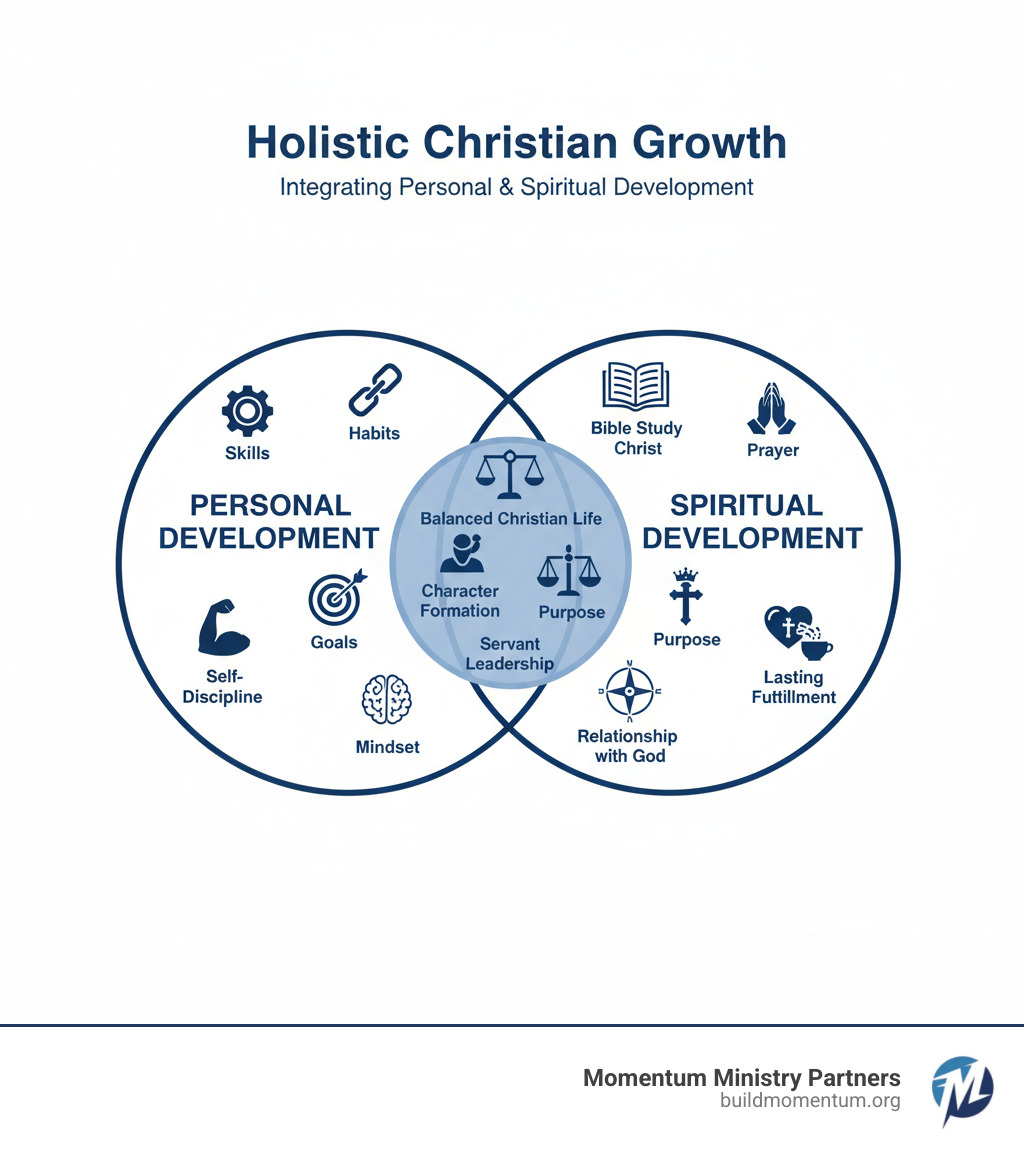
Defining the Two Paths: Personal vs. Spiritual Development

While personal and spiritual development are deeply connected, they focus on different parts of who you are. Think of it this way: personal development is about doing—the skills you build and the goals you achieve. Spiritual development is about being—who you are in Christ and your relationship with God.
It’s the difference between working on your resume and working on your soul. Between asking “What can I accomplish?” and asking “Who am I in God’s eyes?” The beautiful truth is that you don’t have to choose. When you understand how they work together, you’ll find a more complete and fulfilling path forward.
What is Personal Development?
Personal development is the intentional work of improving your habits, sharpening your skills, and expanding your emotional and mental capacity. It’s about taking an honest look at where you are and making deliberate choices to grow. This growth shows up in practical ways, such as:
- Improving habits and mindset: Learning to manage your time, developing positive thought patterns, or building routines that set you up for success.
- Developing specific skills: Honing abilities like public speaking, conflict resolution, or strategic planning.
- Maturing emotionally and socially: Handling stress better, communicating more clearly, and navigating complex situations with greater wisdom.
When you invest in personal development, you’re building the practical foundation that supports everything else. You’re creating the discipline and structure that makes consistent spiritual practices possible, which is a key part of building Christian character.
What is Spiritual Development?
Spiritual development takes you deeper. It’s not about what you can do, but about who you are becoming in Christ. It’s the journey of finding your identity in Christ, deepening your connection to God, and nurturing your soul.
Personal development asks, “How can I improve?” Spiritual development asks, “Who am I, really?” It moves beyond the roles you play to explore your authentic self as God created you to be. This journey involves:
- Finding your true identity: Your worth comes from being created in God’s image and redeemed by Christ, not from your accomplishments or failures.
- Feeding your soul: Practices like prayer, Bible Study, and worship are lifelines that sustain your spirit.
- Revealing your ultimate purpose: Spiritual development connects your daily work to God’s eternal purposes, giving meaning to everything you do.
This is what the basics of spiritual growth in students is all about—helping young believers build a relationship with God that leads to genuine, life-changing faith.
Comparison: Personal Development vs. Spiritual Development
| Aspect | Personal Development | Spiritual Development |
|---|---|---|
| Focus | The Self (Ego, Personality) | The Soul (Spirit, True Self in Christ) |
| Goal | Achievement, Skill-building, Self-improvement | Connection, Purpose, Surrender to God’s will |
| Process | “Doing” – Acquiring skills, changing habits | “Being” – Cultivating identity, deepening faith |
| Questions | “What can I achieve?” “How can I improve?” | “Who am I in God?” “What is my purpose?” |
| Foundation | Psychology, success principles, habit formation | Scripture, prayer, faith, relationship with God |
Both paths are valuable and necessary. The question isn’t which one to choose—it’s how to walk both paths simultaneously, letting them strengthen and inform each other.
The Essential Connection: How Personal and Spiritual Development Intertwine

After three decades in ministry, I’ve learned that personal and spiritual development aren’t competing paths—they’re dance partners. When one leads, the other follows, and together they create something far more powerful than either could alone. When we integrate both personal discipline and spiritual depth, we experience the kind of holistic change that reflects Christ’s character in every area of life.
I’ve watched countless leaders flourish when they grasp this connection, and I’ve also seen talented people burn out when they neglect it. The synergy between these two types of development creates a balanced life rooted in a Biblical worldview.
How Personal Development Supports Spiritual Growth
Your ability to show up for morning prayer has a lot to do with your time management skills. Your capacity to serve others consistently depends on your habits and self-discipline. Personal development creates the structure that holds your spiritual life together.
When you learn to set goals in your career, you’re learning skills that help you maintain consistent Bible reading. If you want to integrate your spiritual life into a busy career, you need both spiritual commitment and practical time management.
Mindset work is also spiritual work. When you challenge negative thought patterns, you remove barriers to faith. If you believe you’re incapable of change, you’ll struggle to trust God’s power. Personal growth helps clear away the mental clutter that blocks your spiritual vision. As you develop communication skills, overcome fears, and learn to lead, you become more willing to step out in faith and take risks for the Kingdom.
The Dangers of an Imbalanced Approach to Personal and Spiritual Development
Trying to grow with just one focus is like paddling a canoe with one oar—you work hard but go in circles.
When you focus only on personal development, you might achieve success but feel hollow. You’ve been chasing goals without connecting them to God’s purpose. This path often leads to an ego-driven existence where success becomes an idol, and burnout isn’t far behind.
The other extreme is equally problematic. I’ve met believers with deep spiritual insights who can’t seem to function in everyday life. They have profound faith but lack the practical skills to lead effectively or maintain healthy relationships. Spiritual development without personal discipline can leave you disconnected from reality, so heavenly minded that you’re no earthly good.
This imbalance also shows up in ministry leadership. You might have a genuine calling but lack the personal boundaries needed to sustain it long-term. The Biblical model is integration. Jesus was both deeply spiritual and remarkably practical. He spent nights in prayer and days healing, teaching, and organizing. That’s the balanced life we’re called to pursue.
A Practical Guide to Christian Personal and Spiritual Development

Understanding the connection between personal and spiritual development is one thing; living it out is another. The good news is that you don’t need a complicated system. You just need a willingness to take practical, consistent steps that honor both your growth as a person and your walk with God. Let’s look at specific ways you can cultivate both aspects of growth.
Key Practices for Fostering Spiritual Growth
Your spiritual life needs intentional practices that create space for God to work. These aren’t religious hoops to jump through—they’re pathways to Him.
- Prayer: Your direct conversation with God. It feeds your spirit and realigns your perspective with His. If you’re a leader, learning how to teach and model prayer can transform your community.
- Bible Study: Engaging with living, active truth that shapes your worldview. Daily reading grounds you in God’s promises. For those working with youth, essential student Bible study books can be a game-changer.
- Worship: Shifting your focus from yourself to God. It cultivates awe and reverence, pulling you out of your own concerns and into His presence.
- Fellowship: Christian community provides support, encouragement, and accountability. When you share life with other believers, you grow together.
- Christian Service: Putting your faith into action. When you serve others, you reflect Christ’s love to the world. The beauty of Christian service is that it grows both your character and your capacity to love like Jesus.
- Solitude and Reflection: Creating intentional quiet time to hear God’s voice. Jesus Himself regularly withdrew to pray—if He needed it, so do we.
Start small. Pick one or two practices to focus on consistently and let them become natural rhythms in your life.
Integrating Key Virtues into Your Journey
Beyond practices, certain character qualities are essential for holistic growth. These virtues are cultivated through intentional focus and God’s work in you.
- Self-Awareness: The foundation of all growth. It means understanding your strengths, weaknesses, and motivations, but more importantly, grasping your identity in Christ—who God says you are.
- Gratitude: This transforms your perspective from scarcity to abundance, from complaint to praise. Research from Harvard Medical School shows that gratitude can improve overall well-being and happiness. Gratitude combats inadequacy by helping you see what God has already given you.
- Faith: More than intellectual belief, it’s trust and reliance on God. Faith empowers you to live by trust rather than sight, believing God’s promises when you can’t see the full picture. It helps you overcome self-imposed limitations and step boldly into the life He’s calling you toward.
Understanding the Journey: The Stages of Spiritual Growth
Growth doesn’t happen overnight. Our journey of personal and spiritual development unfolds gradually. Understanding where you are in this process helps you extend grace to yourself, recognizing that spiritual maturity is a lifelong process, not a destination.
Think of spiritual growth as a spiral staircase. You might feel like you’re covering the same ground, but each time you circle around, you’re at a higher level. Your character deepens, and your perspective expands.
From Foundational Beliefs to Mature Faith
-
Stage 1: Cleaning Up. We establish foundational beliefs and learn Biblical principles. Right and wrong are distinct, and rules provide comfort. This stage is essential for new believers to find stability in clear answers.
-
Stage 2: Growing Up. Life presents complexities that challenge our categories. This is where many experience a crisis of faith, but it’s actually a sign of healthy growth. You wrestle with doubt and develop a personal faith that goes deeper than inherited beliefs.
-
Stage 3: Waking Up. This brings a deepening self-awareness. You realize your true identity is found in Christ alone, not in your accomplishments or performance. You let go of the need to be right and become more present to God’s work in everyday moments.
-
Stage 4: Showing Up. Your inner change flows into outward action. You embody compassion and serve others from an overflow of what God has done in you. You focus on investing in others, fostering young Christian leadership, and finding your place in God’s kingdom work.
How This Journey Transforms Your Life
As you progress through these stages, you’ll notice profound changes. Character development becomes evident as the fruits of the Spirit—love, joy, peace, patience—become your natural responses. Your perspective shifts dramatically, viewing life’s challenges through an eternal lens and discerning what truly matters.
Your relationship with the world also transforms. You move beyond simplistic judgments and learn to love people who are different. You become an agent of reconciliation, building Christian community wherever you go. This journey equips you to live with purpose, grounded in Christ, and ready to make a lasting impact for His kingdom.
Frequently Asked Questions about Personal and Spiritual Development
You’re not alone if you have questions about how personal and spiritual development work together. Let’s address some of the most common questions.
What is the main difference between personal and spiritual development?
Think of it this way: personal development is about becoming more capable, while spiritual development is about becoming more Christ-like. Personal development focuses on improving your skills, habits, and achievements—what you “do.” Spiritual development focuses on nurturing your soul and deepening your relationship with God—who you “are” in Christ.
Can I have spiritual growth without personal discipline?
While God’s grace is the foundation of spiritual growth, personal discipline is the trellis on which that growth is supported. Practices like setting aside time for prayer, developing the habit of daily Bible reading, and managing your schedule to serve others are forms of personal development. They create the structure and intentionality that allow your spirit to flourish. You’re not earning God’s favor; you’re creating space for Him to work.
Where should I start my journey of personal and spiritual development?
A great starting point is self-awareness through prayer and reflection. Ask God to reveal one or two areas for growth. Then, begin with small, consistent habits. I always recommend starting with just 10 minutes in prayer and Bible reading each morning. As you build this foundation, you’ll naturally find other areas to grow, such as joining a small group or seeking a mentor. Growth happens one faithful step at a time.
Conclusion
The path forward isn’t about perfection—it’s about integration. As we’ve explored, personal and spiritual development aren’t competing priorities. They’re two wings that allow us to soar in our faith and calling.
You can master leadership techniques, but without spiritual depth, those accomplishments will feel hollow. You can have profound theological knowledge, but without practical skills, you’ll struggle to translate that faith into action.
God calls us to be whole people—growing in character, competence, and connection to Him. This is the holistic growth that transforms individuals and communities, enabling us to lead with wisdom and serve with excellence.
At Momentum Ministry Partners, we’ve witnessed this change countless times. We’ve seen leaders find that integrating both dimensions of development didn’t dilute their mission—it amplified it.
So where do you go from here? Start where you are. Carve out ten minutes for Bible reading and prayer. Address a leadership skill you’ve been avoiding. Find a mentor who can walk alongside you.
The journey is lifelong, but each step brings you closer to becoming the leader God designed you to be—equipped with both the heart of Christ and the tools to serve His kingdom effectively.
Find guidance for your growth journey through Christian Mentoring, and find how Momentum Ministry Partners can support your continued development as you pursue both purpose and peace.





0 Comments