
Why Gen Z Religion Matters for Church Leaders Today
Gen Z religion is experiencing a dramatic change. Here’s what you need to know:
Key Gen Z Religious Trends:
- 48% are religiously unaffiliated – the highest percentage in American history
- 18% identify as atheist or agnostic – double the rate of previous generations
- Yet weekly church attendance is stabilizing – some metrics show Gen Z attending more than Millennials
- Young men are becoming more religious than young women – a historic first
- 63% doubt religious institutions act beyond self-interest, especially on issues like environmentalism
- Catholicism is seeing a surge among young men seeking structure and community
The story of Gen Z and faith isn’t simple. While they’re the least traditionally religious generation America has ever seen, they’re also showing unexpected signs of spiritual hunger. Some are returning to church. Others are walking away. Many are somewhere in between – seeking truth, community, and authentic answers in a world that feels increasingly chaotic and disconnected.
The challenge for church leaders is real. Only 40% of Gen Zers attended church weekly as children, compared to 57% of Baby Boomers. Fewer than half believe religion is important in their lives. They’ve grown up watching institutions fail, experiencing unprecedented loneliness (39% felt lonely weekly as children), and navigating a digital world that offers endless spiritual “options” but little depth.
But here’s the hope: this generation is still searching. More than a quarter say they’ve become more religious or spiritual in recent years. Nearly 30% believe in a higher power without doubt. They’re not rejecting spirituality – they’re rejecting hypocrisy, empty rituals, and institutions that don’t practice what they preach.
I’m Jeff Bogue, and for over three decades I’ve been investing in the next generation through pastoral leadership and youth ministry. As President of Momentum Ministry Partners and Senior Pastor of Grace Church, I’ve witnessed how understanding Gen Z religion transforms our approach to discipleship and equips us to reach this generation with the unchanging truth of the Gospel.
The Shifting Landscape of Gen Z Religion: A Tale of Two Trends
The narrative surrounding Gen Z religion is often painted with broad strokes of decline and disinterest. And while it’s true that this generation is markedly different from those before them in their relationship with traditional faith, a closer look reveals a more nuanced, even paradoxical, picture. We see both a significant move away from organized religion and, simultaneously, surprising pockets of spiritual seeking and even a resurgence in certain areas. For us as church leaders, understanding this dual reality is paramount to effective ministry.
The Rise of the “Nones”: Understanding Gen Z’s Religious Disaffiliation
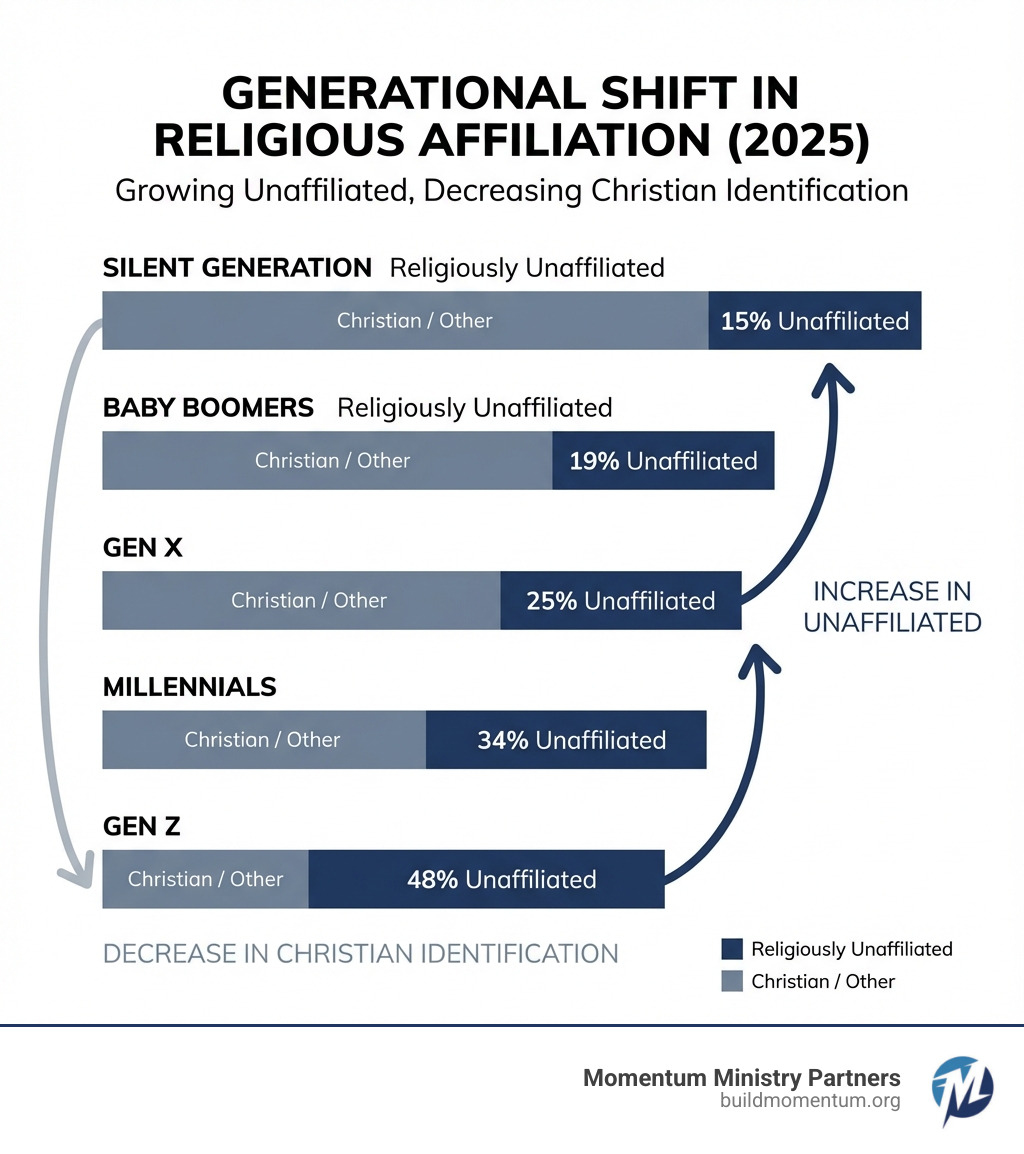
When we examine the data, the trend is clear: Gen Z is the least religious generation in American history. A staggering 48% of Gen Z identifies as religiously unaffiliated, a term often colloquially referred to as “nones.” This figure represents a significant leap compared to previous generations, where the religiously unaffiliated stood at 29% for Millennials, 25% for Gen X, 19% for Baby Boomers, and only 15% for the Silent Generation. This demographic shift is not merely about a lack of affiliation; it’s also reflected in belief. A substantial 18% of Gen Z affirmatively identifies as either atheist (9%) or agnostic (9%), a rate double that of earlier generations. This deep dive into Gen Z’s religious makeup from PRRI provides comprehensive insights into these trends.
Several factors contribute to this widespread disaffiliation. One significant element is their upbringing. Gen Zers are far less likely to have experienced robust religious formation during childhood. For instance, only 40% of Gen Zers attended church weekly growing up, compared to 57% of Baby Boomers. Similarly, participation in Sunday school or other religious education programs saw a drop, with 42% of Gen Zers attending compared to 61% of Baby Boomers. Even informal religious practices at home, like saying grace or family meals, have declined. While 76% of Baby Boomers had daily family meals, only 38% of Gen Z did, impacting the intergenerational transmission of faith.
Beyond personal experience, Gen Z harbors a deep skepticism of institutions. A striking 63% of Gen Zers express doubt in the genuine commitment of religious institutions to act beyond their own self-interest, particularly on critical issues such as environmental stewardship. This perceived hypocrisy, coupled with the politicization of faith and stances on social issues like LGBTQ+ identity, often creates a significant barrier. Gen Z, being more diverse and liberal-leaning (31% identify as Democrats, 39% of women identify as liberal), often finds traditional religious doctrines at odds with their core values of inclusivity and social justice. When they see religious bodies prioritizing political agendas or demonstrating a lack of action on global crises, their trust erodes, leading to disengagement.
A Surprising Resurgence: Where Faith is Finding New Life
Despite the stark figures on disaffiliation, the story of Gen Z religion isn’t entirely one of decline. In fact, we’re observing fascinating counter-trends that suggest a deeper spiritual hunger beneath the surface. Experts like Ryan Burge note that the decades-long decline in religious attendance may be tapering off, with some metrics indicating that young people are actually more likely to be weekly religious attenders than Millennials. This is a significant shift that we haven’t seen before. The number of Americans identifying as religiously unaffiliated, after decades of increase, has recently begun to stabilize at around 30 percent, and experts suggest Gen Z may be the reason for this stagnation as they come of age and maintain their religious affiliation.
What drives this unexpected turn? For many Gen Zers, the search for answers and security in an uncertain world is a powerful motivator. This generation has grown up amidst political unrest, economic instability, and the isolating impacts of the COVID-19 pandemic. They report feeling lonely more often than previous generations, with 39% of Gen Zers feeling lonely at least once a week during childhood. Organized religion, when it functions authentically, offers a balm to this loneliness: community, structure, and a sense of belonging. As some Gen Zers articulate, they “always had questions and felt like something bigger was out there” and that “there’s no other place to turn to in order to see what’s wrong with life.” For more resources on reaching the next generation, check out the Momentum Ministries blog page.
This spiritual seeking isn’t just about belonging; it’s about genuine belief. More than a quarter of young people report becoming more religious or spiritual over the past few years. Nearly 30% state they know a higher power exists and have no doubts about it, significantly more than the 15% who don’t believe in a higher power at all. This indicates a generation open to the transcendent, even if they’re wary of the institutional.
Interestingly, a notable trend within this resurgence is the rise of young men leaning into conservative Christian churches, including a significant increase in young men participating in Catholicism. This marks a historic shift from the traditional pattern where women were generally more religious. For these young men, these churches often provide a sense of security and order in what they perceive as a chaotic world.
For us, these trends highlight a critical opportunity. The secular landscape doesn’t mean a spiritual void; it means a different approach is needed. Our mission to equip church leaders for communicating Christ in a post-Christian culture becomes even more vital as we steer this complex terrain.
Key Drivers: What Influences Gen Z’s Faith Choices?
Understanding Gen Z religion isn’t just about statistics; it’s about delving into the motivations and external forces that shape their spiritual journeys. This generation is highly discerning, and their choices are influenced by a blend of personal experiences, societal pressures, and a deep-seated desire for authenticity. Check out these Momentum Youth Conference students’ stories!
The Search for Authenticity, Community, and Belonging
If there’s one overarching theme in Gen Z’s approach to faith, it’s the demand for authenticity. They are a generation that values action over words, and this applies directly to their view of religious institutions. As we’ve seen, 63% of Gen Zers doubt the genuine commitment of religious institutions to act beyond their own self-interest. This means that merely professing a faith isn’t enough; they need to see it lived out in tangible ways. If a church preaches love but practices exclusion, or advocates for creation care but remains silent on environmental issues, Gen Z notices. Their critique is sharp: “It’s not enough to preach love for all creation if words aren’t matched with tangible action against climate change.”
This demand for authenticity is closely tied to their profound need for community and belonging. Gen Z has grown up in an era of digital connection but often real-world isolation. The loneliness statistics are sobering: 39% of Gen Zers felt lonely at least once a week during their childhoods, a stark contrast to previous generations. The COVID-19 pandemic further exacerbated feelings of isolation, leaving many craving genuine human connection. When religious communities offer true, unconditional belonging—places where individuals feel seen, heard, and valued—they can be incredibly attractive. We’ve observed that organized religion can offer the community and security that is critically appealing to Gen Z, especially those who grew up amidst political unrest and significant societal changes.
Building trust with this generation requires transparency, vulnerability, and a willingness to engage with their questions and concerns, rather than dismissing them. They are looking for safe spaces where they can be themselves and forge meaningful relationships. Our work at Momentum Ministry Partners emphasizes equipping leaders to foster these environments, laying the foundation for the basics of spiritual growth in students.

The Gender Divide and Its Impact on Gen Z Religion
One of the most striking and unprecedented developments in Gen Z religion is the emergence of a clear gender divide. For the first time in modern American history, men in Gen Z appear to be more religious than women. This is a reversal of long-standing trends and warrants our careful attention.
This shift is particularly evident in the increased engagement of young men with conservative Christian churches. Data indicates that Gen Z men are more likely than Gen Z women to support Christian Nationalism, espouse Apocalypticism, and even express familiarity with ideas such as repealing women’s right to vote. Furthermore, Gen Z men are more prone to viewing themselves as victims of modern culture and are more likely to identify as Evangelical. This trend is not confined to one denomination; Catholicism, for example, is seeing a notable rise in young men.
This phenomenon is intricately linked to what some researchers describe as “grievance culture” and “gender anxiety.” In a rapidly changing world, some young men are searching for clear structures and defined roles. Online influencers, often dubbed “TheoBros,” actively promote “traditional” gender norms and expectations across social media platforms like TikTok and YouTube. While some of their rhetoric can be problematic, it resonates with young men seeking answers to questions of identity and purpose. These conservative churches and movements often promise a sense of security and a return to what they perceive as order in an uncertain world.
Conversely, Gen Z women, who are more likely to identify as LGBTQ+ (31% vs. 18% of men) and lean liberal (39% vs. 34% of men), often find traditional religious institutions less accommodating to their progressive values and identities. This contributes to a higher religiously unaffiliated rate among women compared to men in this generation. For church leaders, understanding this complex gender dynamic is crucial when considering 3 disturbing cultural trends youth pastors need to address. It challenges us to create inclusive environments that uphold Biblical truth while also addressing the unique anxieties and aspirations of both young men and women.
Politics, Social Justice, and the Christian Worldview
Gen Z religion is inextricably linked with their political and social consciousness. This is a generation deeply concerned with justice, equity, and the state of the world, and they expect their faith—or lack thereof—to align with these values.
This strong social conscience translates into a demand for consistency from religious institutions. As noted earlier, 63% of Gen Zers doubt the genuine commitment of religious institutions to act beyond self-interest, particularly in areas like environmental stewardship. When doctrines appear to promote exclusion rather than love, or when there’s silence on crucial social justice issues, Gen Z becomes wary. They are largely skeptical of Christian Nationalism, with 69% qualifying as rejecters or skeptics, and this skepticism is even higher among Gen Z women.
For a generation raised on the internet, exposed to diverse viewpoints and global injustices, the call to live out a Christian worldview means more than just personal piety. It means demonstrating Christ’s love and justice in the public square, advocating for the marginalized, and actively working for a better world. Churches that ignore these concerns or appear to be out of step with these values risk alienating a significant portion of this generation. Our challenge is to articulate and embody a robust Biblical worldview that engages with these complex issues with both grace and truth.
How to Minister to Gen Z in a Post-Christian Culture
Given the unique landscape of Gen Z religion, traditional approaches to ministry may fall short. We must adapt, innovate, and, most importantly, remain grounded in the unchanging truth of the Gospel. Our goal is not to simply attract Gen Z, but to disciple them into a deep and abiding faith in Jesus Christ.
Digital Discipleship: Engaging the “Always Online” Generation
Gen Z lives online. For many, the internet is not just a tool; it’s a primary sphere of existence. As one Gen Zer quipped, “The internet has been my Sunday school.” Digital immersion and social media act as “virtual congregations” where spiritual exploration, debate, and community formation happen. This presents both challenges and unparalleled opportunities for ministry.
The challenge lies in the sheer volume of information—and misinformation—available. TikTok faith trends, while engaging, can be superficial or even lead young people down un-Biblical paths. However, the opportunity is immense. We can intentionally create positive, authentic online content that speaks to Gen Z’s questions and concerns. This isn’t about being “hip” for the sake of it, but about leveraging their native language and platforms to share the Gospel. Digital small groups, online Bible studies, and thought-provoking discussions on platforms where Gen Z gathers can serve as vital connection points. Just as we explore what Fortnite has to do with Jesus to understand their world, we must similarly engage their digital spaces for discipleship. Our presence online, reflecting the love and truth of Christ, can cut through the noise and offer a genuine spiritual home.
From Curated Spirituality to Biblical Depth
Gen Z, like Millennials before them, often approaches spirituality with an individualistic mindset, sometimes creating a “spiritual salad bar” by blending beliefs from various traditions. While this reflects a personal search, it can also lead to a lack of theological grounding and a superficial understanding of faith. For many, curating spiritual practices without a deeper understanding of their meaning can be difficult and ultimately unsatisfying.
Our role is to gently guide them from this curated spirituality to the rich, life-changing depth of Biblical truth. This means teaching core Christian doctrines not as rigid rules, but as liberating truths that offer meaning, purpose, and a coherent worldview. The authority of the Bible, when presented with grace and relevance, can provide the solid foundation they crave in a shifting world. We encourage young people to engage with the Scriptures directly, to wrestle with its truths, and to find the living God within its pages. This is why initiatives like Why bring your Bible to school day matters are important—they encourage personal ownership of faith and engagement with the Divine Word. Moving beyond surface-level faith requires intentional discipleship that digs into the heart of what we believe as Christians.
Creating Spaces for Tough Questions and Honest Dialogue
Gen Z values authenticity above almost all else. This means they need spaces where they can bring their toughest questions, their doubts, and their skepticism without fear of judgment. They are a generation that “always had questions and felt like something bigger was out there,” and they are looking for “no other place to turn to in order to see what’s wrong with life” than a genuine community.
We must cultivate environments where doubt is not seen as a threat to faith, but as a pathway to deeper understanding. This involves addressing controversial topics head-on—whether it’s the relationship between science and faith, issues of sexuality and the Church, or the complex interplay of politics from the pulpit. When churches shy away from these conversations, Gen Z interprets it as a lack of authenticity or an inability to defend their beliefs.
Instead, we are called to embody grace and truth, offering a compassionate yet Biblically faithful response to their inquiries. Mentorship plays a crucial role here, as experienced leaders can walk alongside young people, listening patiently, sharing wisdom, and modeling what it looks like to steer these complex issues with integrity. By building safe environments for honest dialogue, we demonstrate that the Christian faith is robust enough to handle their hardest questions and that the Church is a place where they can truly belong. Our resources on Christian values meet culture: youth discussion are designed to equip leaders for these vital conversations.
We often encounter common questions as we work with church leaders and youth ministers trying to understand and reach this pivotal generation. Here are some of the most pressing:
Conclusion: Partnering to Reach the Next Generation for Christ
The landscape of Gen Z religion is undeniably complex, marked by both an unprecedented level of disaffiliation from traditional institutions and a persistent, authentic search for truth, meaning, and belonging. This generation is not a lost cause; rather, they represent a mission field ripe for a Church that is willing to listen, adapt, and embody the radical love of Christ. They are wary of hypocrisy, hungry for genuine community, and deeply concerned with justice and authenticity.
For us, as leaders committed to equipping the Church, this is a clear call to action. We must innovate our approaches, listen intently to the unique questions and anxieties of Gen Z, and lead with courage, grounded in the unchanging truth of the Bible. Our mission at Momentum Ministry Partners is to empower local churches and their leaders to effectively connect with, disciple, and empower the next generation. By understanding the intricate “Gen Z Faith Factor,” we can build bridges where walls once stood and effectively share the transformative hope of Christ with the leaders, innovators, and world-changers of tomorrow.
We believe that the future of the Church depends on our ability to engage this generation with intentionality and love. It requires a commitment to Biblical depth, authentic community, and a willingness to step into their world with compassion and understanding. Together, we can open up the potential for powerful discipleship and ensure that the Great Commission continues through the hearts and lives of Gen Z.
To further equip your ministry and find practical tools for reaching this vital generation, we invite you to explore resources for actually reaching the next generation available through Momentum Ministry Partners.






0 Comments